MARCUS LICINIUS CRASSUS — BLOCK I: EPIC EXPANSION
I1 — Why Crassus belongs in the same series as Pompey and Caesar
The First Triumvirate is usually told as a two-man drama with a wallet attached. That is a mistake, and it makes bad history.
Without Crassus, Caesar's early ascent is harder, slower, more fragile — less liquidity, more creditors at the door. Without Crassus, Pompey's frustration has one less bargaining partner when the Senate digs in. Without Crassus, the 50s BC lose their unstable triangle, the only arrangement that postponed civil war by giving three appetites temporary satisfaction.
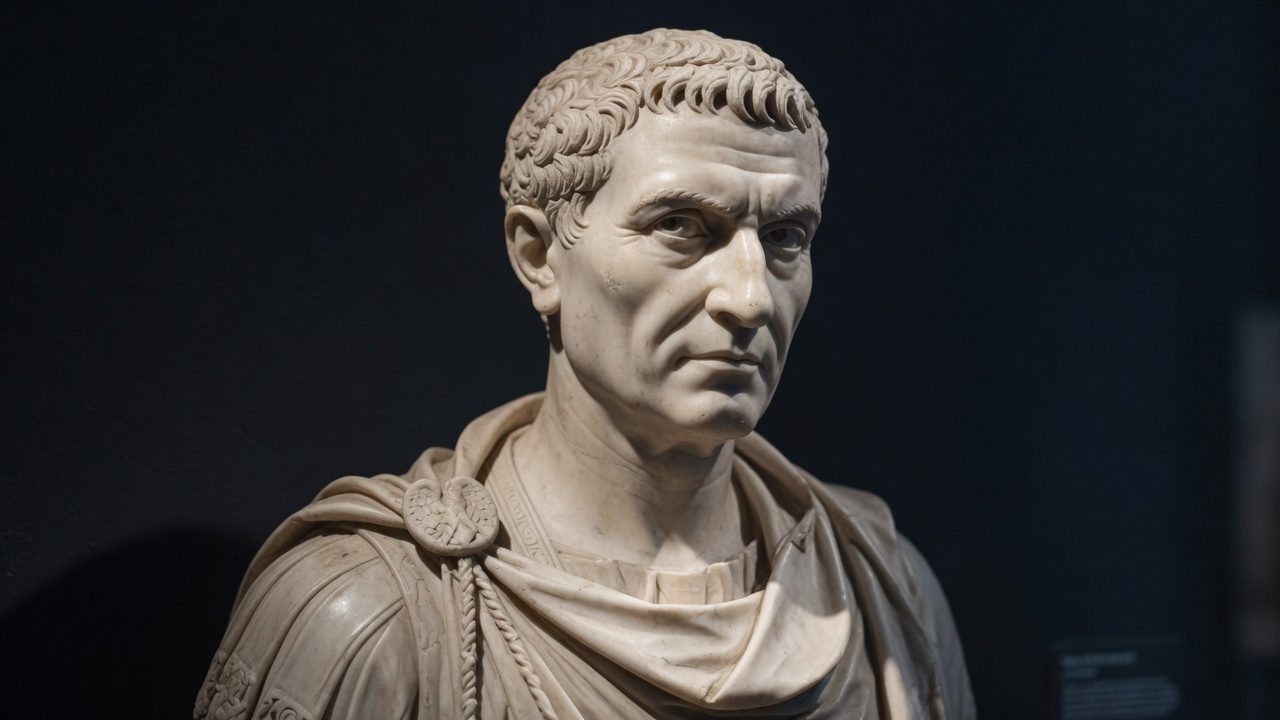
He is not the most charismatic man of his age. He is one of the most necessary. Necessity is a historical force. This documentary treats him as a protagonist — not a footnote who dies in the desert for moral decoration on someone else's poster.
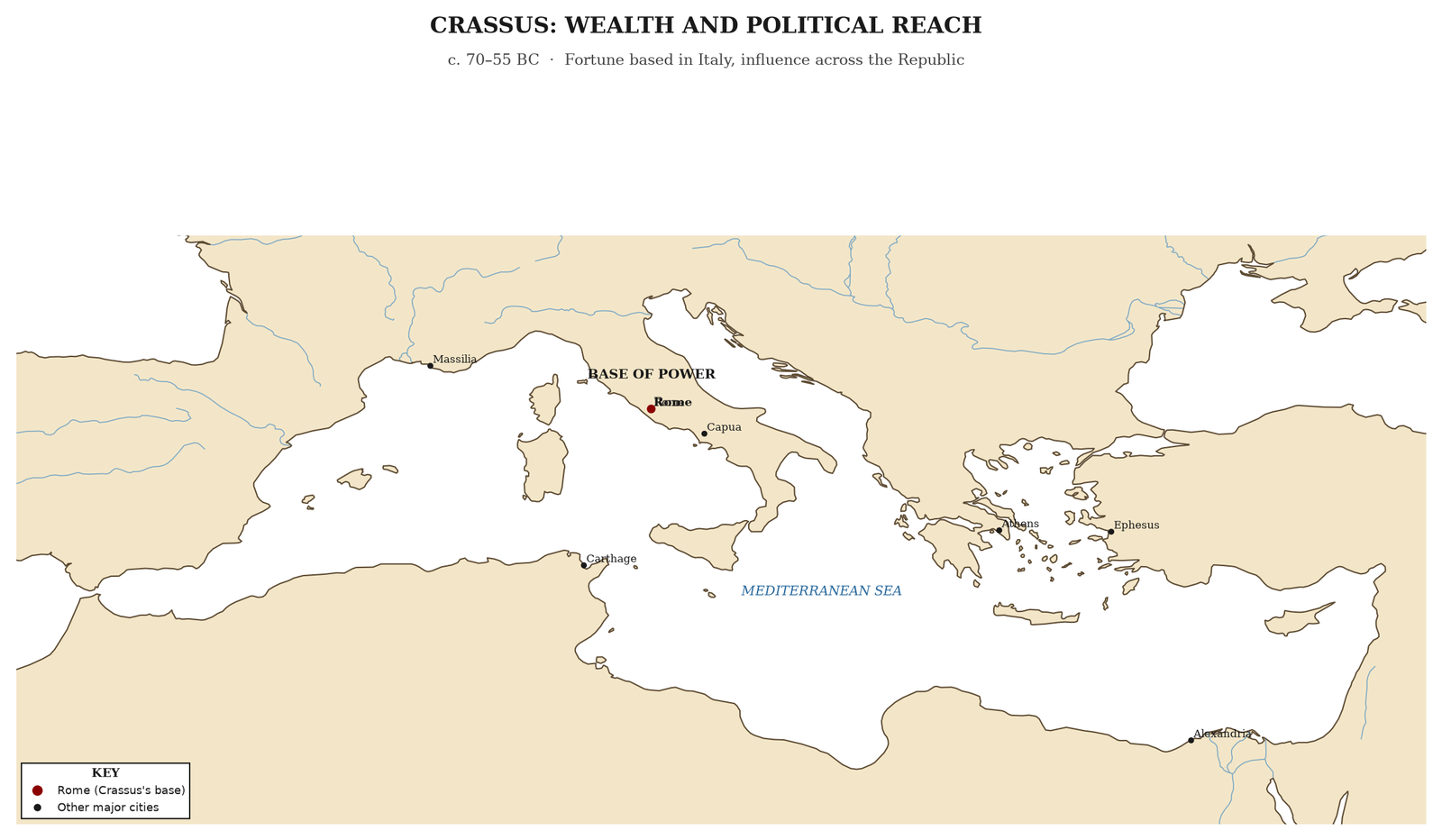
If Pompey is glory and Caesar is genius, Crassus is capital. And capital, in the late Republic, is how elections run, how clients are made, and how private deals become public law.
I2 — The education of fear
Marcus Licinius Crassus grows up noble and becomes hunted.
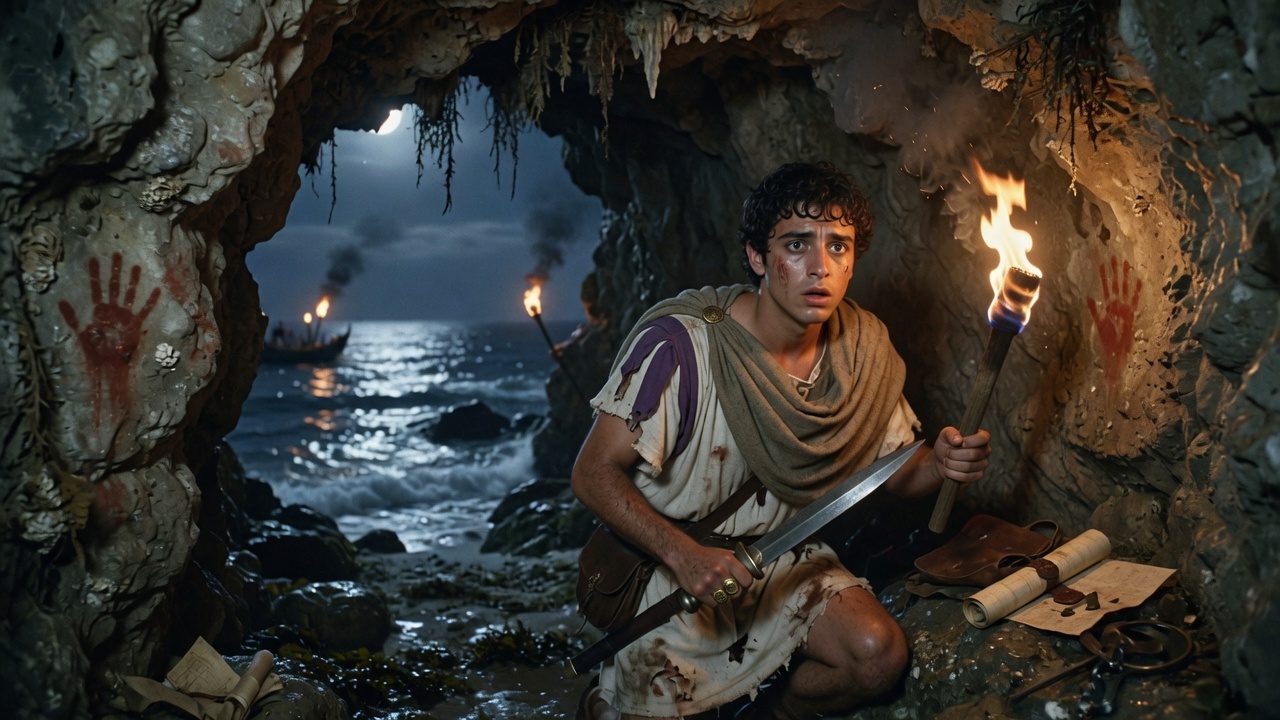
In the civil convulsions of the 80s BC, family status is not armor. It is a target painted in factional colors. His father, Publius Licinius Crassus, had reached the consulship and fought in Spain — standing that meant something until Marian and Cinnan politics turned the wrong affiliation into a death sentence. Father and brother die in the bloodletting. Young Marcus flees.
The fugitive years matter because they explain the adult. Traditions put him in Spain, surviving in hiding — even a cave, in the novelistic tellings. Whether every romantic detail is exact, the scar is real. Men who have been one decree away from annihilation often spend the rest of their lives stacking insurance: money, clients, armed dependents, political options. Crassus stacks all four.
When he returns under Sulla's victory, he does not return as a philosopher of reconciliation. He returns as a man who understands that Roman law can become a shopping list. Proscriptions name the dead and price their estates. Crassus acquires. Ancient sources accuse him of adding names for profit, of buying at funeral prices. Hostile writers exaggerate; the direction of the story still holds. Later moralists call it greed. A colder reading calls it civil-war literacy.
He learns the first rule of the late Republic: the safest property is the property you can defend with the winning army. He never fully washes the stain off. He also never stops compounding the principal.
I3 — Building the fortune: a city as balance sheet
Peace does not make Crassus gentle. It makes him systematic.
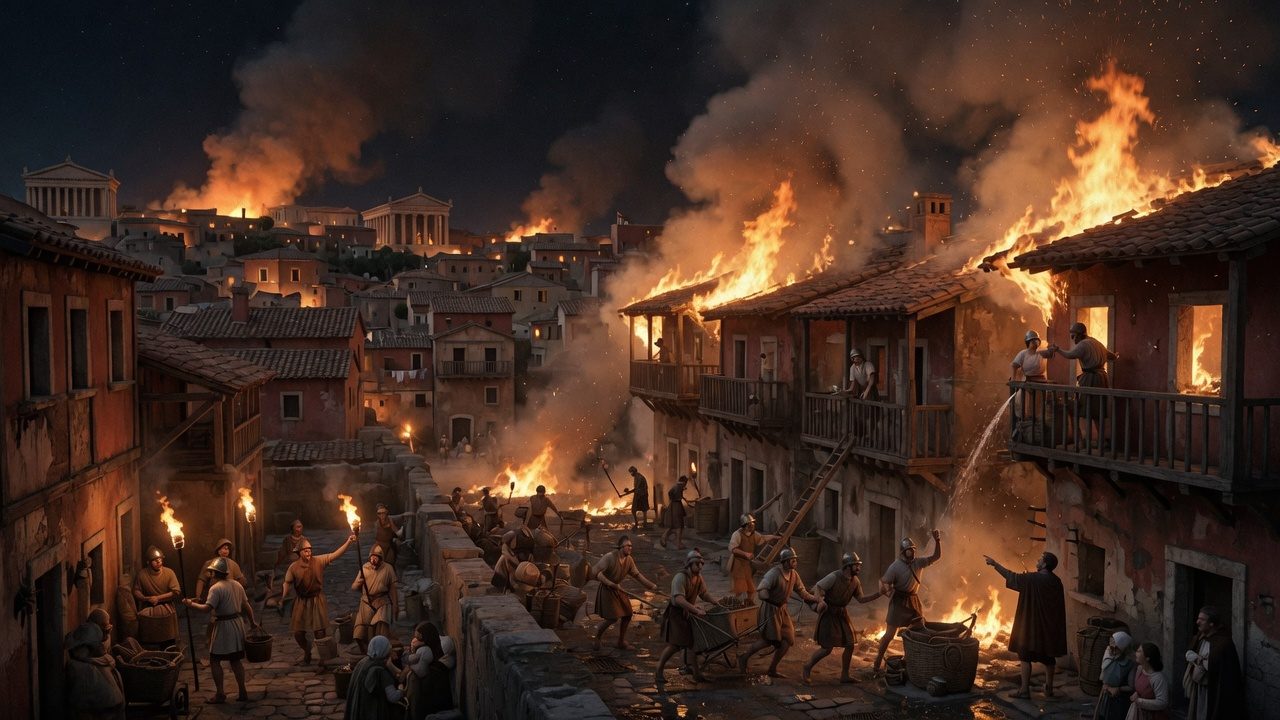
Rome is crowded, flammable, and full of ambitious men who need credit. Crassus becomes a node where urban disaster, human bondage, and elite politics intersect.
The fire brigade story is the one everyone remembers for a reason. Private firefighters. Panic purchases. Neighboring lots scooped up as flames spread. While a building burns, he offers a discount price; if the owner sells, the brigade works; if not, the opportunity improves with the fire. Hostile tradition may polish the cruelty. It survives because Romans found it believable. It matched the man they thought they knew — someone who could look at a tragedy and see a closing.
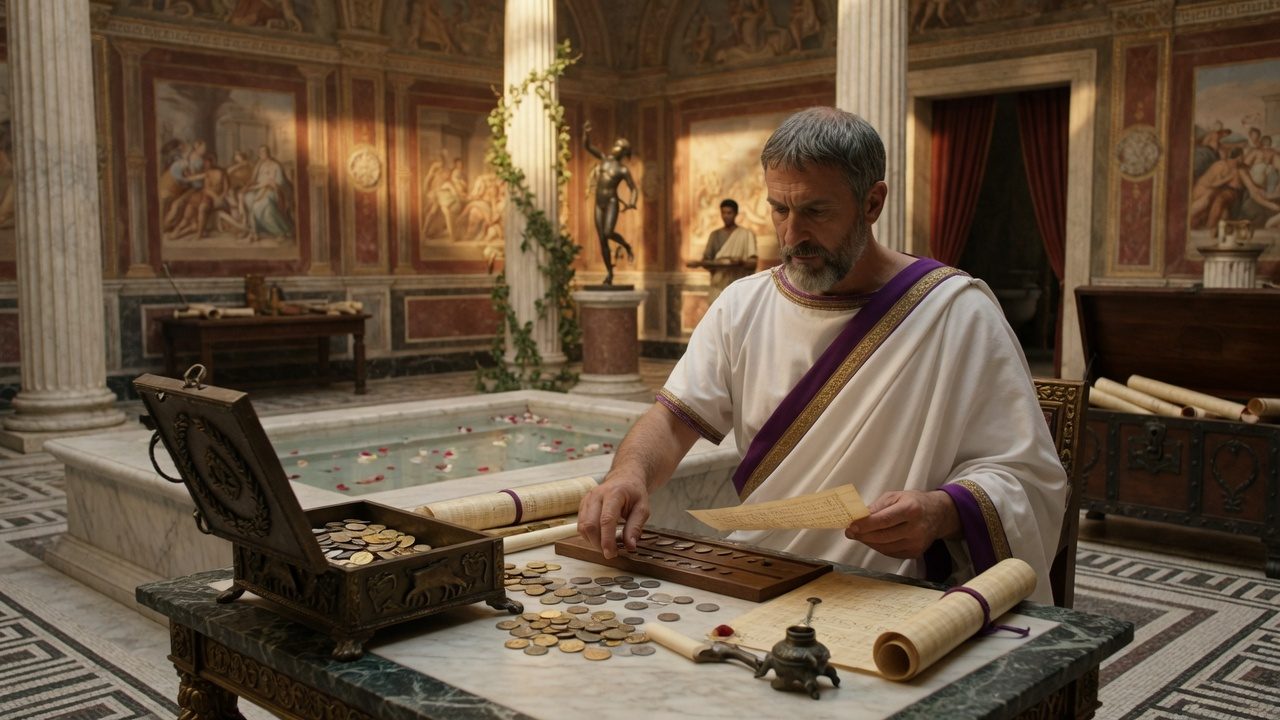
He invests in silver mines. He trains slaves not only for muscle but for literacy and skilled labor, multiplying the return on human property. Modern ethics recoils; Roman elite economics does not blink. He lends to politicians. He collects obligations the way Pompey collects provinces. A loan from Crassus is never only finance. It is a leash with interest.
By the time Romans call him the richest man alive, wealth has become his public identity. Ancient estimates, converted into modern money, go fantastic; the social fact matters more than the spreadsheet. He can underwrite elections, networks, emergencies. That identity is power. It is also a trap. In a culture that ranks triumphs above treasuries, infinite money can still feel like second place.
Crassus will spend the rest of his life trying to buy first place.
I4 — Spartacus: the war that should have been enough
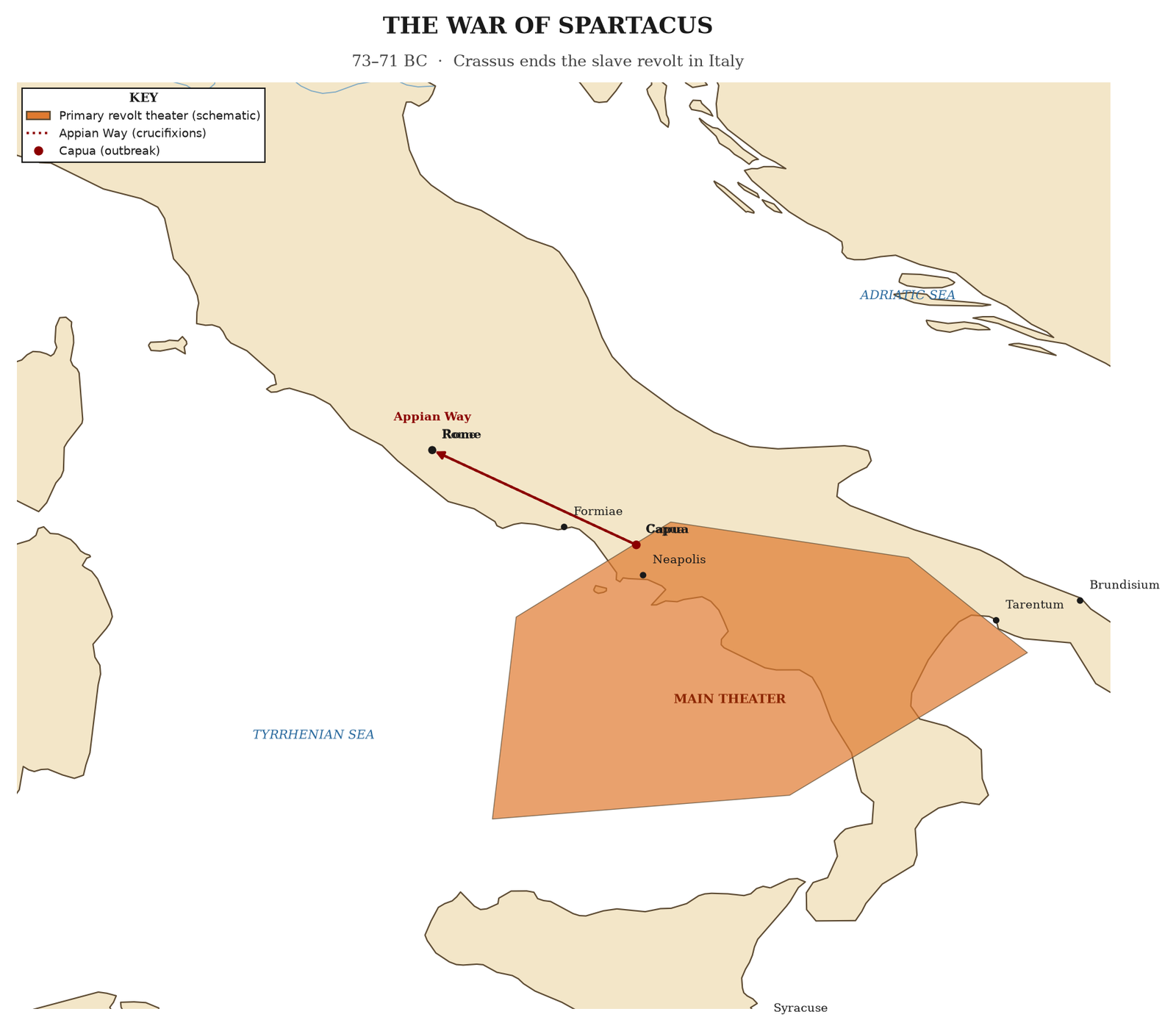
The revolt that begins in Capua in 73 BC is a social nightmare wearing military flesh.
Gladiators escape a training school. Fields empty into rebel columns. Roman commanders underestimate, then fail, then panic. Italy — not some distant frontier — becomes the theater. For slaveholders, this is apocalypse preview: the tools learning to fight the masters. For Crassus, it is opportunity wearing terror.
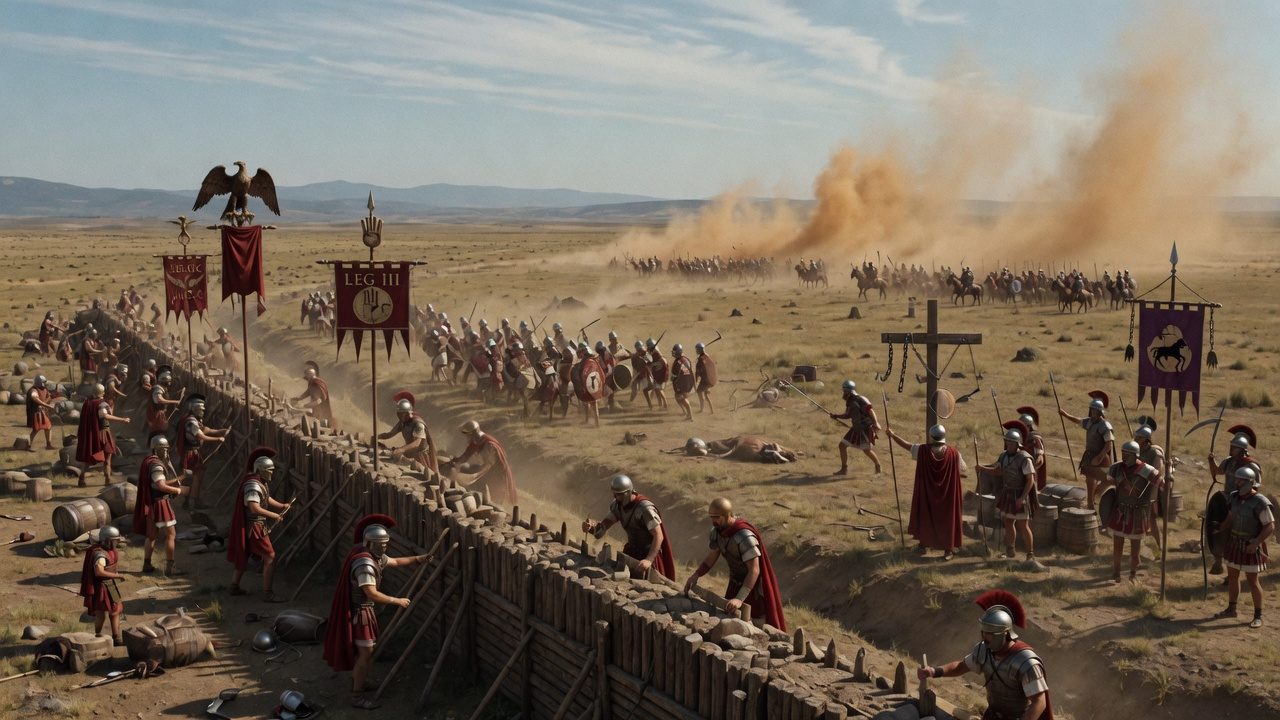
He raises legions with private energy and public authority. He imposes discipline severe enough that later writers preserve decimation stories — kill a fraction of a cowardly unit to frighten the rest into bravery. Source issues apply; the management style fits. He attempts to cage Spartacus with monumental fieldworks across the southern peninsula, engineering as prison. Spartacus breaks out. The war stays fluid and humiliating for the state.
Eventually Roman weight and Crassus's persistence break the revolt. Spartacus falls in battle in the tradition that matters to Roman memory: not as a romantic freedom statue, but as a general of the damned who nearly embarrassed an empire, fighting, they say, toward Crassus's own person.
Then the road.
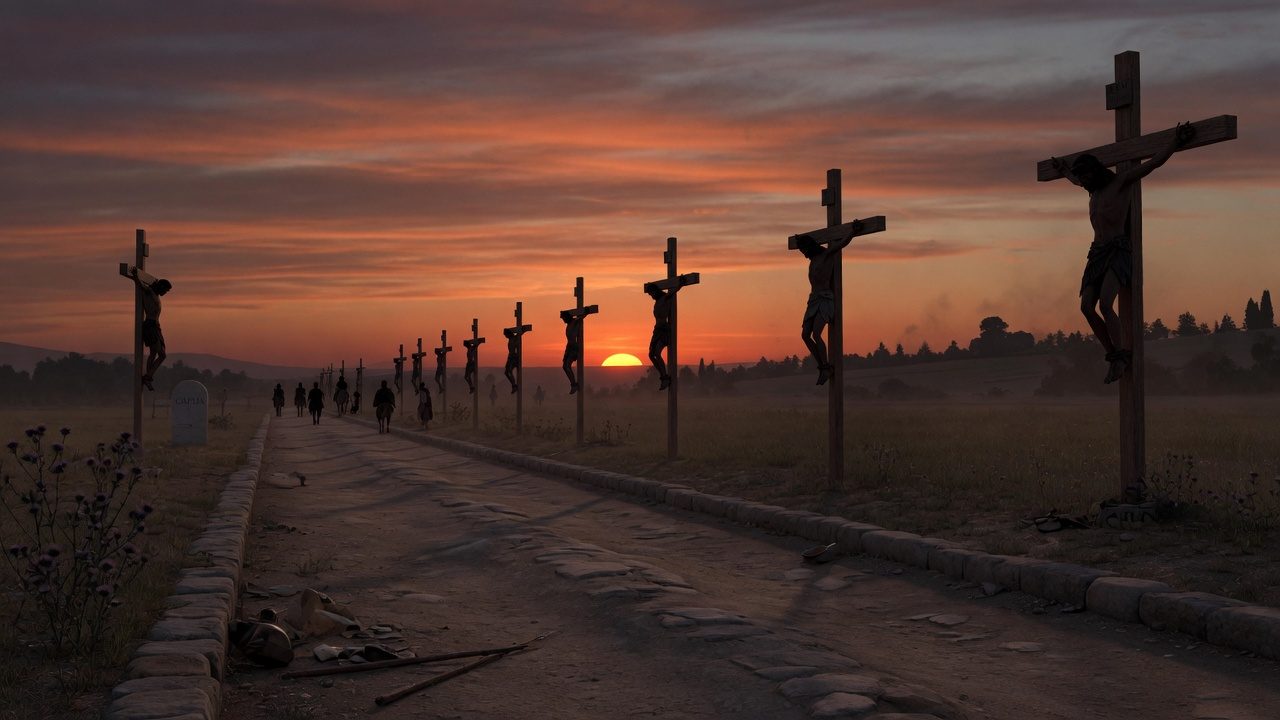
Thousands crucified along the Appian Way from Capua to Rome — six thousand, if you trust the figures. A lesson written in wood and agony. Modern ethics recoils; Roman order applauds. If a documentary flinches from this, it flinches from Rome. Crassus is not a cartoon villain for enforcing a slave society's survival. He is that society's authorized instrument.
He has every right, in Roman terms, to expect the central glory of the decade.
Pompey, returning from Spain, takes a slice of the ending and a larger slice of the credit. Intercepts leftover bands. Writes himself into the victory narrative. Crassus, who did the grinding campaign, watches the headline walk away.
The consulship they share in 70 BC is a public marriage of convenience. They restore powers to the tribunes. They perform reconciliation. Private resentment becomes structural. Crassus will never again fully trust the marketplace of reputation to reward the man who did the work.
Spartacus made him necessary.
Pompey made sure necessity was not enough.
I5 — The politics of the third man
Through the 60s, Crassus operates as financier-statesman. He is linked to equestrian interests, to popularis machinery when useful, to every rumor that swirls around debt and conspiracy. Ancient sources sometimes try to tie him to Catiline's world; modern historians argue. What is solid is his omnipresence. When Rome shakes, Crassus's name appears near the fault line.
His most consequential investment is Gaius Julius Caesar.
Caesar has pedigree, charm, nerve, and catastrophic early spending habits. Games, elections, debts — the popularis startup cost. Crassus provides liquidity and political cover. In some crises he stands surety so Caesar can leave for a province without creditors seizing him first. In return Crassus holds paper on the future. When Caesar later becomes the dominant military genius of the age, that loan book looks either prophetic or cursed.
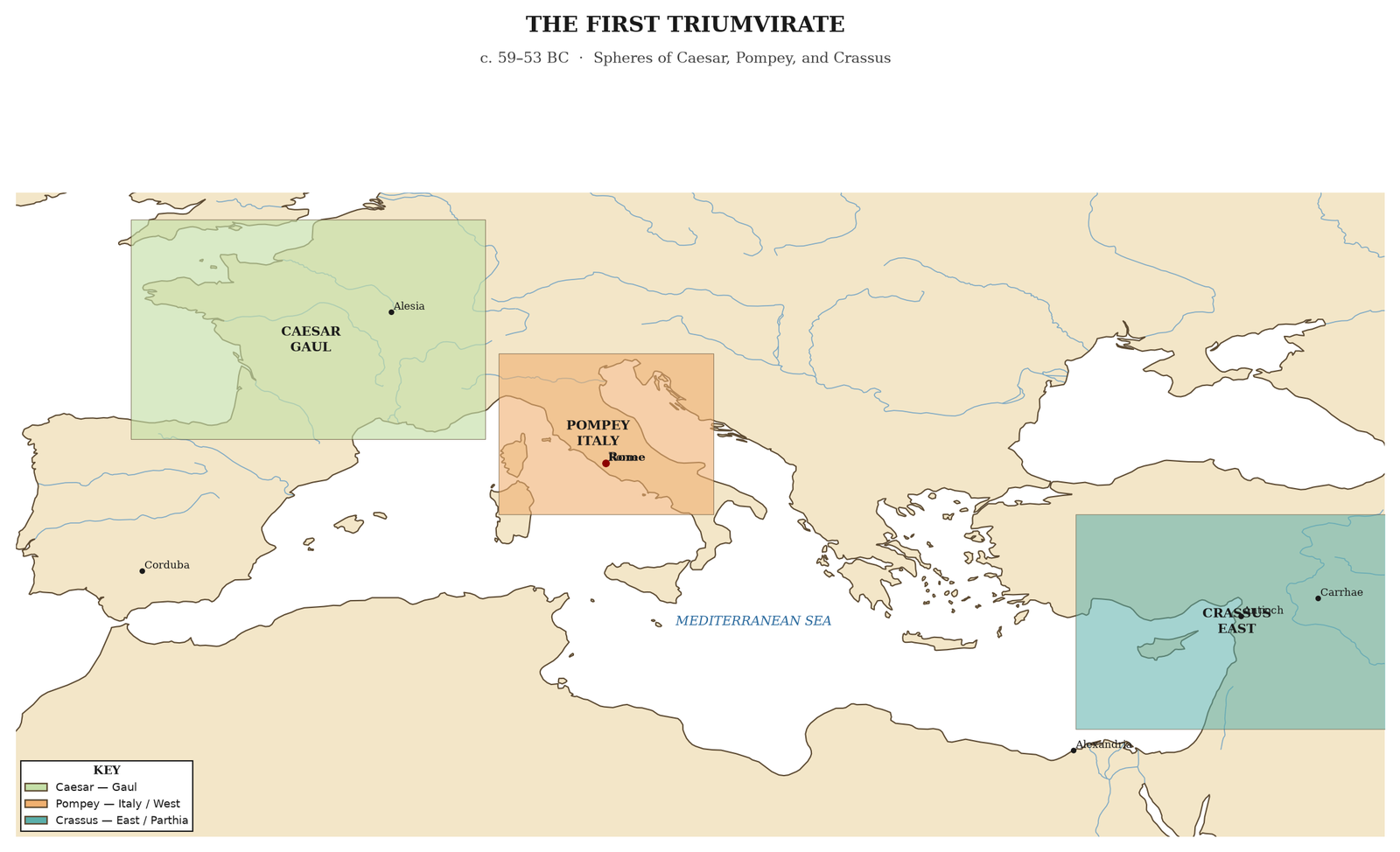
Around 60 BC, private talks produce the First Triumvirate. Call it what it is: a cartel of ambition.
Pompey brings veterans and frustrated glory — land for his men, ratification of eastern acts.
Caesar brings political skill and future armies — consulship, long command.
Crassus brings money and the ability to make Roman public life expensive for enemies — recognition equal to his wealth, protection of interests, a path to glory still denied him.
Together they can outvote, outspend, and outmaneuver a Senate that still believes ancestral dignity is a strategy. Cato and the hard optimates, by obstructing, help manufacture the solidarity they fear. For a few years, it works. Caesar as consul in 59 BC delivers for partners. Luca in 56 BC is the cartel's re-IPO: commands extended, provinces allocated, the map treated as a spreadsheet of personal futures.
Crassus leaves Luca with Syria in his eyes and Parthia in his dreams.
I6 — Why invade Parthia?
Because Pompey has the East's settlement fame.
Because Caesar is writing himself into Gaul forever.
Because Crassus is aging out of the only tournament that still defines Roman manhood at the highest level.
Because the Parthian Empire is the peer rival that makes an eastern war sound like Alexander cosplay for adults.
Because money has bought him everything except the sentence "Crassus the Great."
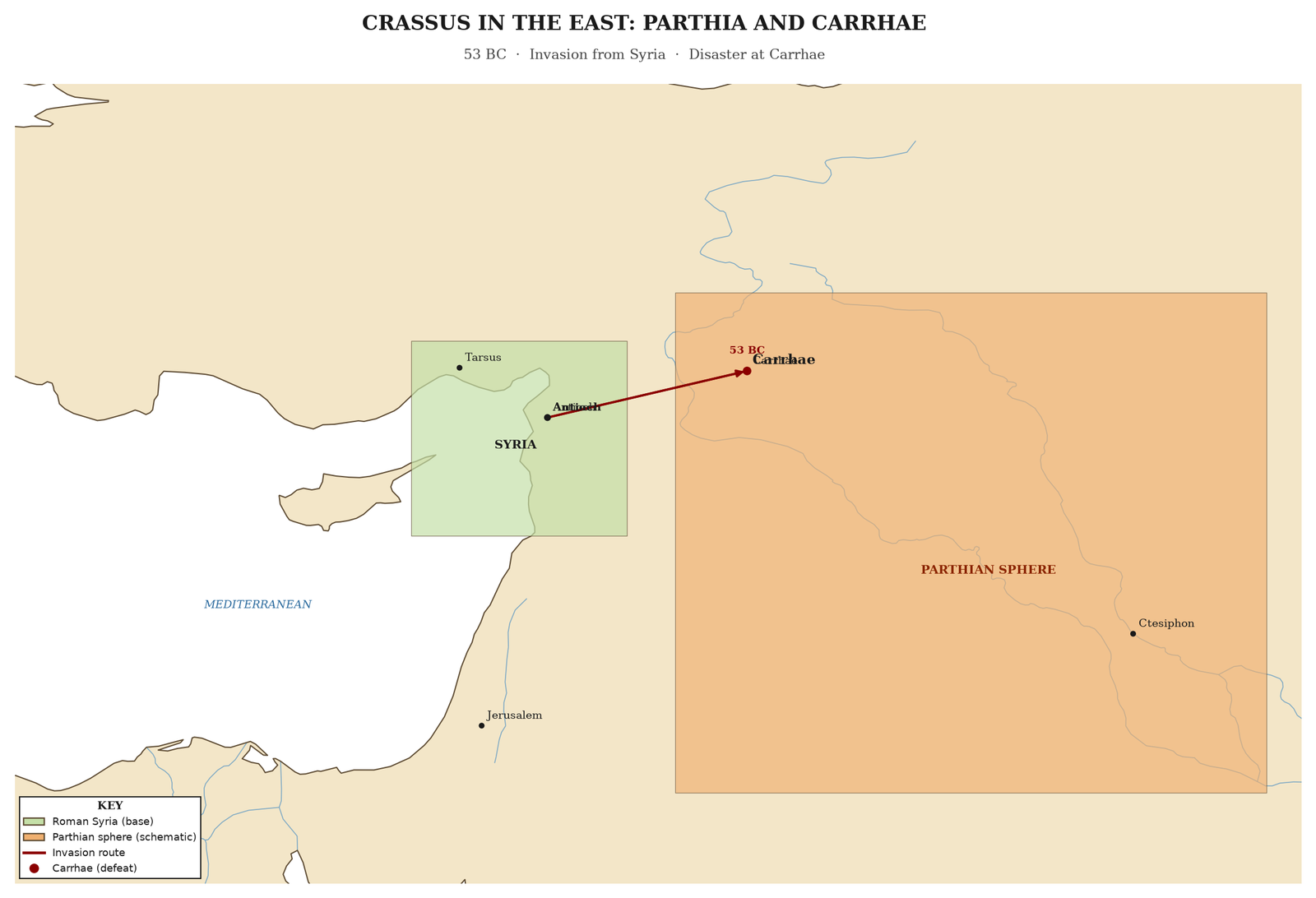
He takes Syria as a launchpad, not a quiet governorship. He extracts wealth. He prepares invasion. He dismisses caution — careful routes, better coordination with Armenian allies in that shifting world — when it gets in the way of the timetable in his head.
Friends doubt him. Enemies mock him. Tribunes stage resistance. Later writers stack omens because Carrhae demands foreshadowing. He goes anyway. Hubris is too simple a word. This is prestige panic in a man who can price provinces but cannot price his own hunger.
He is going east to buy immortality.
He will purchase a catastrophe instead.
I7 — Carrhae, slowly
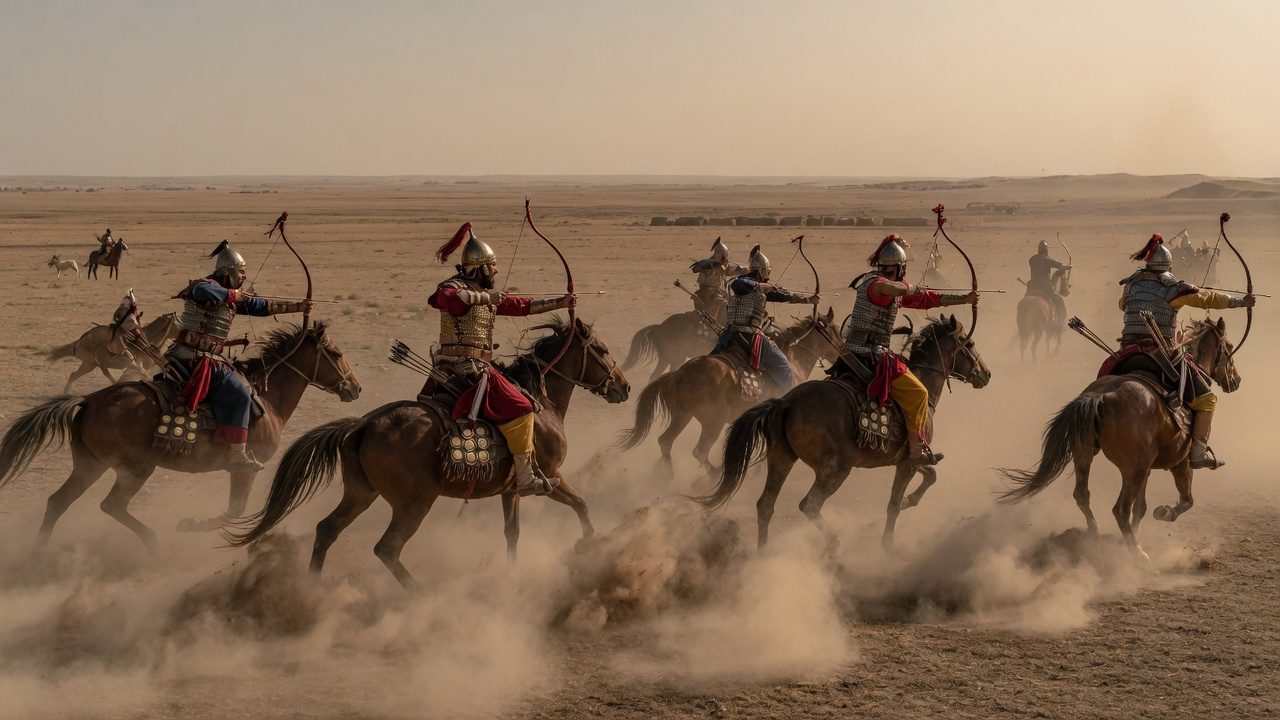
The invasion of 53 BC is a collision between Roman self-confidence and Parthian military reality.
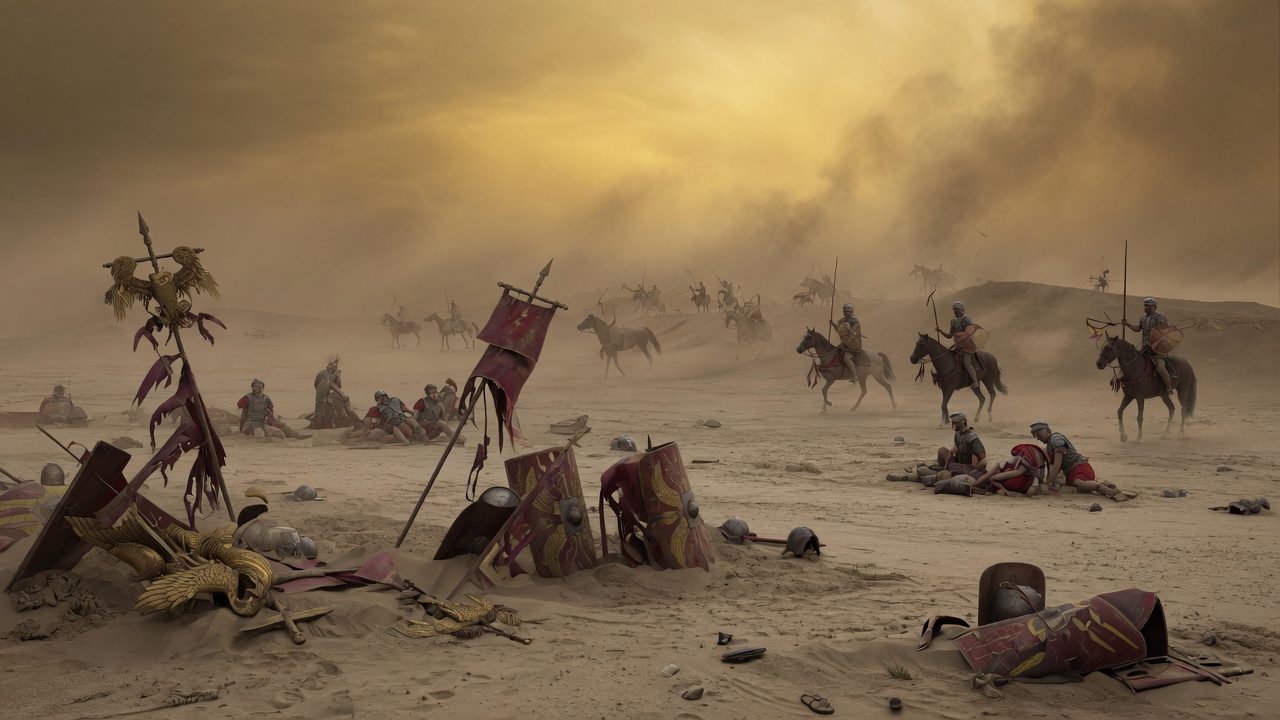
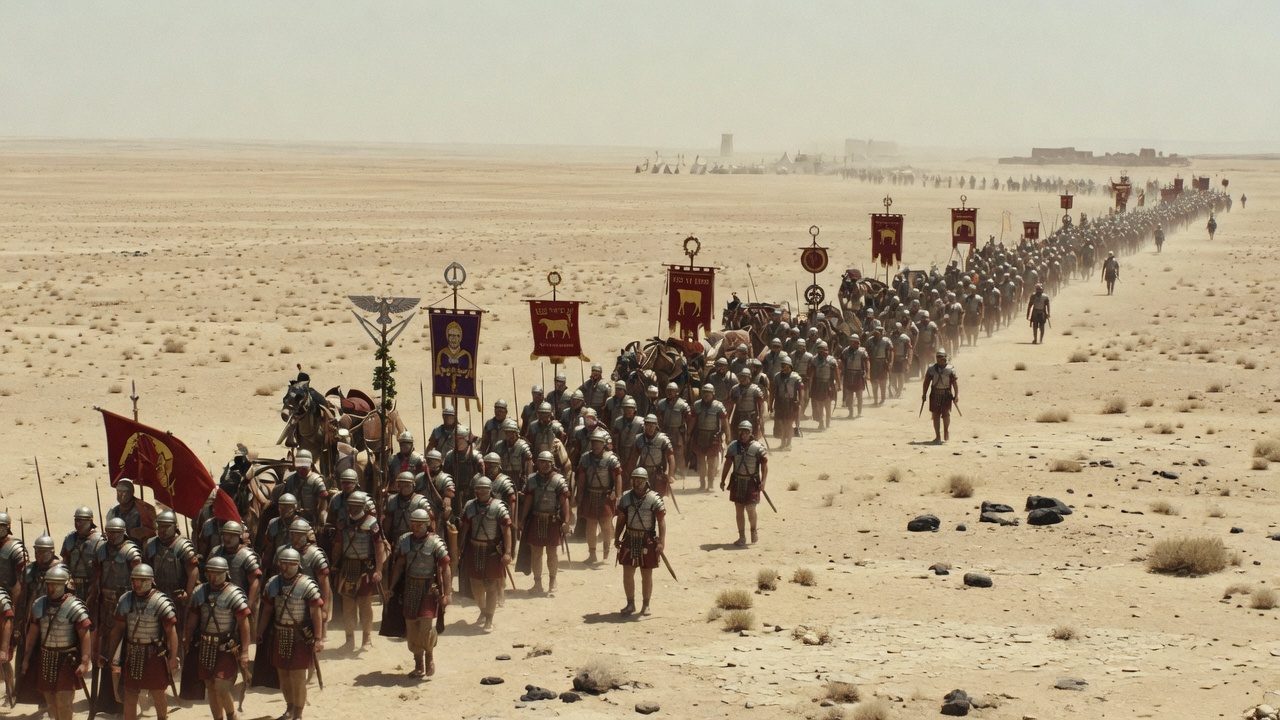
Roman legions are history's most successful heavy infantry system. On the wrong plain, against horse archers who refuse to die in a grapple, that system becomes a target set. Surena — younger, outnumbered in some tellings, lethally adapted to the environment — uses mobility, missile dominance, and terrain logic. Cataphracts wait for the right hammer blow. Arrow weather does not stop. Some accounts give camel trains carrying resupply — industrial skirmishing. Roman cavalry hopes fail. Testudos bake and bleed. Local guides and logistics turn sinister.
Publius Crassus, the son, is destroyed in a gallant catastrophe that breaks the father's strategic and emotional spine. The army tries to move by night. Cohesion frays. Thirst does the rest. Negotiations begin because annihilation is becoming mathematics.
Crassus dies in the contact zone between armies — killed in a parley's collapse. Standards are taken: a spiritual catastrophe for Roman military religion, eagles in foreign hands. Survivors become a Roman trauma story; among them, Cassius will help hold what can be held in Syria and keep a name for later history.
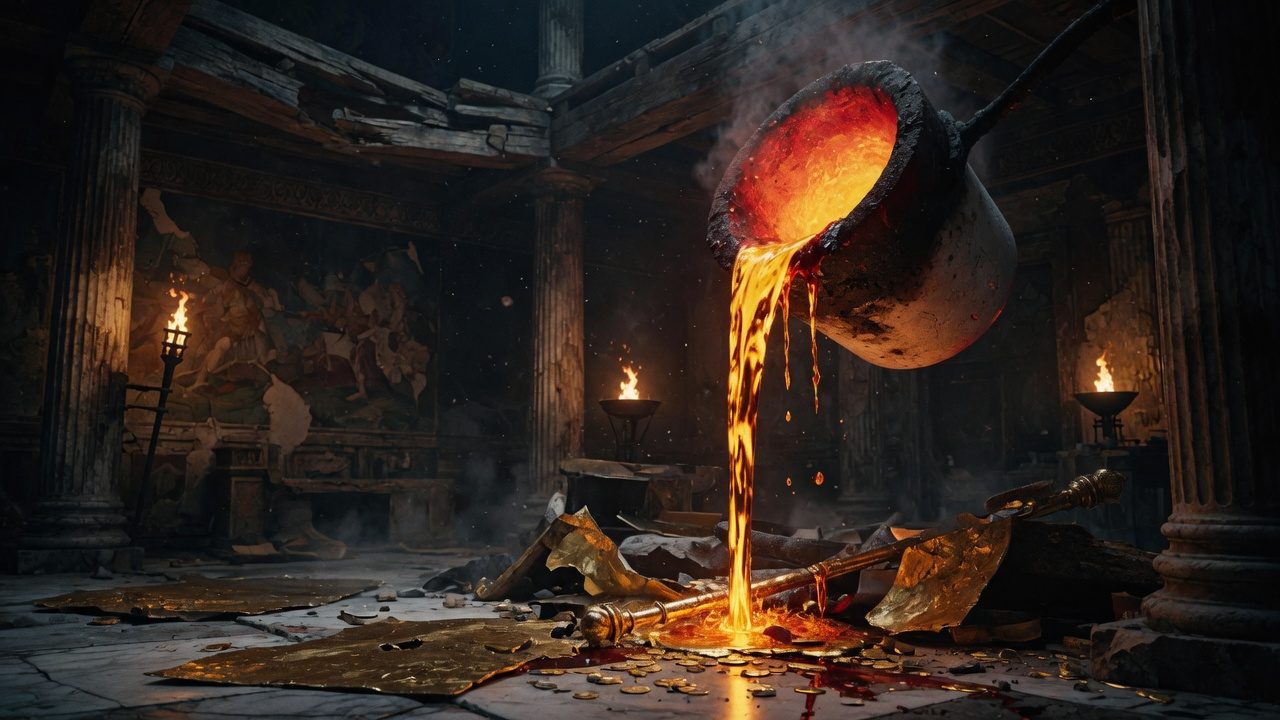
Later writers pour molten gold into the corpse of his reputation because they need greed to explain a disaster that is also about bad military assumptions and a political culture that made bad assumptions rational for ambitious men. Believe the legend or treat it as moral folklore. Either way, it is the epitaph Rome wanted for a man it never quite respected as a warrior.
Carrhae teaches Rome that the East is not a coin farm with costumes. It teaches the Italian political class that the third pillar of their uneasy peace is gone. Standards become holy relics to recover for generations. The myth of easy eastern conquest cracks on open ground.
I8 — After Crassus: the triangle collapses
No more three-way bargain.
No more wealthy mediator with a foot in every camp.
Pompey drifts into senatorial embrace.
Caesar becomes the indispensable enemy of that embrace.
The road to the Rubicon gets shorter.
Within four years of Carrhae, Caesar crosses the river. Within five, Pharsalus. Within a decade-plus, the Republic's corpse is being embalmed into empire.
Crassus does not cause Caesar's civil war alone. He removes a structural delay. In complex systems, removing a delay can be as decisive as adding a spark. He had bankrolled Caesar's rise. He had balanced Pompey just enough to keep three ambitions in one room. Then he took himself off the board at the worst possible moment, in the worst possible way.
Money can delay history.
It cannot command the desert.
I9 — How to judge him
Do not reduce him to the gold legend.
Do not rehabilitate him into a misunderstood hero.
Judge him as a late republican type perfected: the civil-war survivor who turns the city into a portfolio; the slave-war victor who enforces the social order with crucifixion forestry; the political investor who underwrites genius; the aging dynast who dies reaching for a triumph that was never his native language.
He is less beloved than Pompey, less dazzling than Caesar, and in one narrow sense more modern than either. He understands that power is a balance sheet long before it is a battlefield. His tragedy is insisting the battlefield must still rubber-stamp the balance sheet — that first place on the ledger is not first place until a foreign enemy says so.
Schoolchildren remember molten gold. Filmmakers remember Spartacus through other heroes. Historians of Parthia remember Roman humiliation. The structural memory is sharper: private capital and public crisis fused until even infinite wealth could not buy a secure ending in a system addicted to extraordinary men.
I10 — Final oration
[06] → [00] → [02] → [05] → black
Marcus Licinius Crassus counted Rome's ambitions and charged interest.
He bought buildings from fire, loyalty from debt, and a path to command from coalition politics. He defeated the fear named Spartacus and never defeated the envy named Pompey. He funded the future named Caesar and died in the desert trying to become a legend large enough to stand beside them both.
The richest man in Rome discovered the market's limit.
Some things are not for sale.
Some things are only for the taking — by men who already know how to take.
Crassus tried to take Parthia.
Parthia took him.
And the Republic, deprived of its third giant, staggered toward a war that would take everyone else.
End Block I