A wall of words.
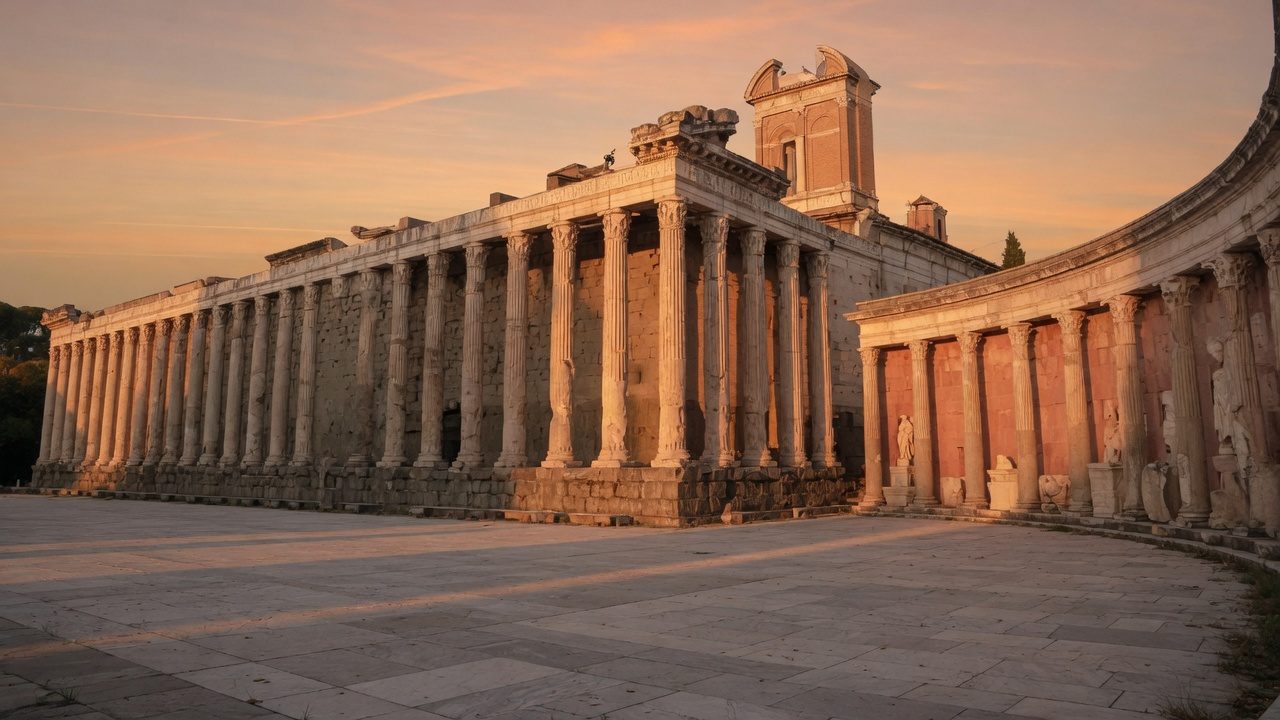
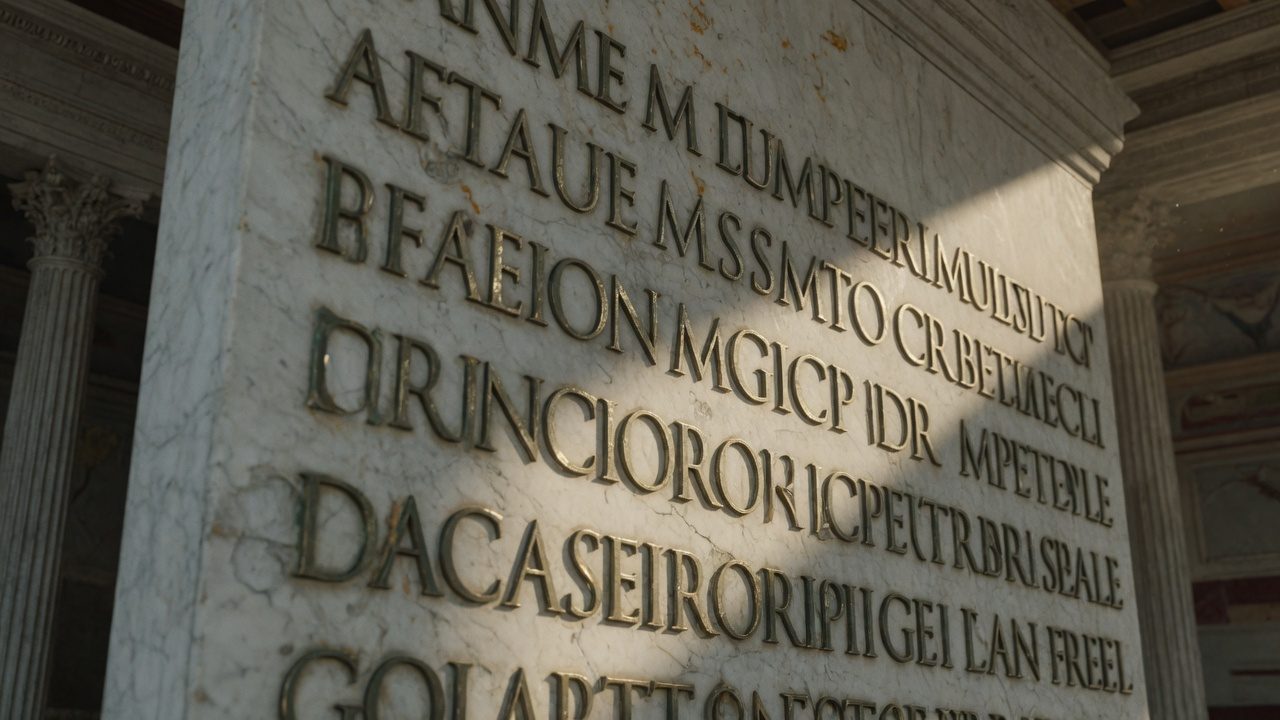
Bronze in Rome, at the Mausoleum, according to the plan he left. Copies in the cities of the empire. The one we can still almost touch is in Ancyra — Ankara — on a temple wall, Latin and Greek, the Res Gestae Divi Augusti, the achievements of the deified Augustus.
Deified. So we are already late. The man is dead. The press release has become scripture.
Walk it anyway as if the bronze were still warm.
It is written in the first person. That is the first choice. Not “the Senate records,” not “the people gratefully.” I. I did this. I restored. I refused. I gave. I built. I spared. I expended. The voice of a man who has decided that the state is a memoir.
It is also a document of refusals.
I refused a dictatorship. I refused a consulship that would have been too much. I refused a crown, in the ways a crown could be offered without using the poisoned word. The Res Gestae is as proud of what he would not be called as of what he did.
That is a press release that understands its audience.
Romans who still flinch at rex can be soothed by a list of noes.
Romans who eat because of him can be soothed by a list of yeses: money to the people, grain, games, temples, roads, a city made worthy of its rumor.
Romans who serve in a legion can be soothed by victories and by the recovery of standards — Parthian standards, taken back by diplomacy and theater, Carrhae’s ghost given a parade without another desert.
What is not on the wall is the government.
There is no honest paragraph that says: I monopolized the eagles.
No paragraph that says: I made Egypt a locked room.
No paragraph that says: my household reads the mail.
No paragraph that says: elections end where I smile.
No paragraph that says: my daughter was broken on the laws I wrote for other people’s bedrooms.
No paragraph that says: I never solved the empty chair except by bleeding my family into it.
Omissions are policy.
A good press release is not a lie in every line. The Res Gestae is full of things that happened. Buildings rose. Money was given. Provinces were arranged. Honors were voted. The first person is not a novelist.
The first person is a curator.
Curators are dangerous in proportion to their taste.
If you only teach the principate from this wall, you will teach a pious giant who restored a commonwealth and went home to modest furniture.
If you teach the principate from the Rhine payroll, the Ostia docks, the 23 BC levers, and this wall together, you will teach a man who knew that memory is a province and who appointed himself governor of it.
He says, on that wall, that he excelled all in auctoritas and did not have more potestas than his colleagues in each magistracy.
We have already held that sentence up to the light.
At the end of the film it deserves one more look, because it is the disguise in a single carved breath.
It asks you to score the game by innings — this consulship, this colleague, this year — and not to add the innings up.
Add them up.
Tribunician years counted like a reign.
Greater command over the men with eagles.
Egypt.
Grain.
Guard.
Chief priesthood.
Father of the country.
A face on the coin.
A wall that will outlast the body.
That sum is a monarchy.
The unit of account is republican.
As long as the city accepts the unit of account, the sum can sit in the room unnamed.
Now the unsolved problem.
Succession.
A Republic, even a damaged one, does not need a royal heir. The year produces magistrates. The chair empties on schedule.
A monarchy needs a body in the chair when the last body cools, or the eagles will hold a seminar.
The principate wants the second fact without the first theory.
So it improvises, for forty years, in flesh.
Watch the flesh.
Marcellus, the nephew, married to Julia. Young. Public. Dead in 23 BC, the same sick year as the Second Settlement. Virgil will later let Anchises, in the underworld, see a bright boy and a funeral. The regime’s poets are not always lying when they sound sad.
Agrippa, the partner. Not a pretty prince. A man who could win and build. Married to Julia after Marcellus. Given the shares of power that make him a spare princeps — tribunician power, command — because 23 BC taught the machine about one pair of lungs. Dies in 12 BC. The lungs fail again.
Gaius and Lucius, the grandsons, sons of Agrippa and Julia, adopted as sons by their grandfather. Raised in public like a double bet. Both die young, Lucius in AD 2, Gaius in AD 4, on the edges of the empire that was supposed to be their inheritance.
Drusus, the younger stepson, the charming one, dead in 9 BC after a fall from a horse in Germany. The sources give you the horse. The machine gives you another hole.
Tiberius, the other stepson, Livia’s son, competent, dark, a general the eagles understand. He is used, set aside, recalled, adopted in AD 4 when the prettier bets are dead. He is made to adopt Germanicus, the bright nephew, so that the future of the future is already arranged.
This is not a family tree for its own sake.
This is a constitution written in funerals.
There is no law that says Tiberius must follow.
There is adoption, which Roman private law already understood — a father making a son who was not born a son. There is the sharing of tribunician power and imperium with the adopted son, so that when the first body dies the second body is already legally warm. There is Julia’s blood, which the regime keeps trying to park inside whoever the current male is. There is Livia, who will walk into the next reign as a problem Tacitus cannot leave alone.
There is the army, which likes a name it already knows.
There is the Senate, which will be asked to make the arrangement look requested.
That bundle is how you succeed without a succession law.
It is also why the principate will keep having succession crises for a century. When the bundle is neat, you get Tiberius. When the bundle is a mess, you get a year of four emperors, later, in a different film. The unsolved problem does not stay polite.
Augustus never puts a diadem on a child.
He puts offices on a child, then on another child, then on a middle-aged general he does not seem to love.
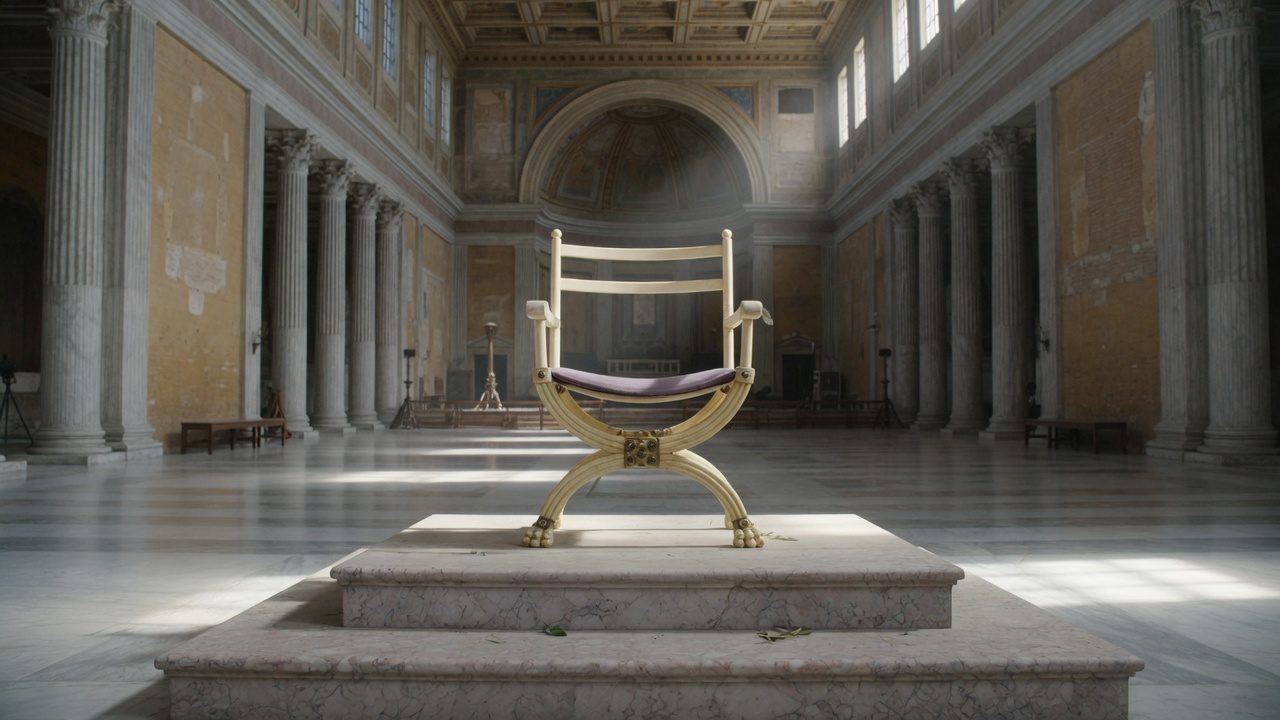
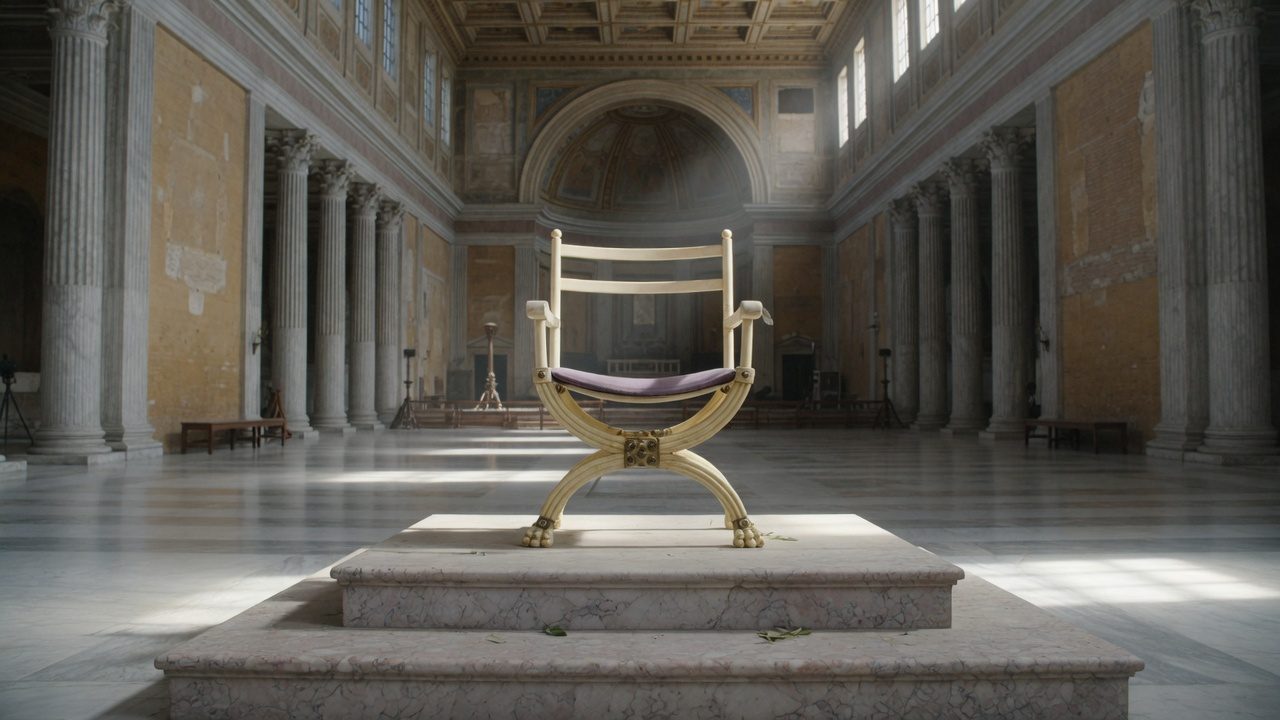
The empty chair is never officially a throne.
It is a set of powers looking for a body.
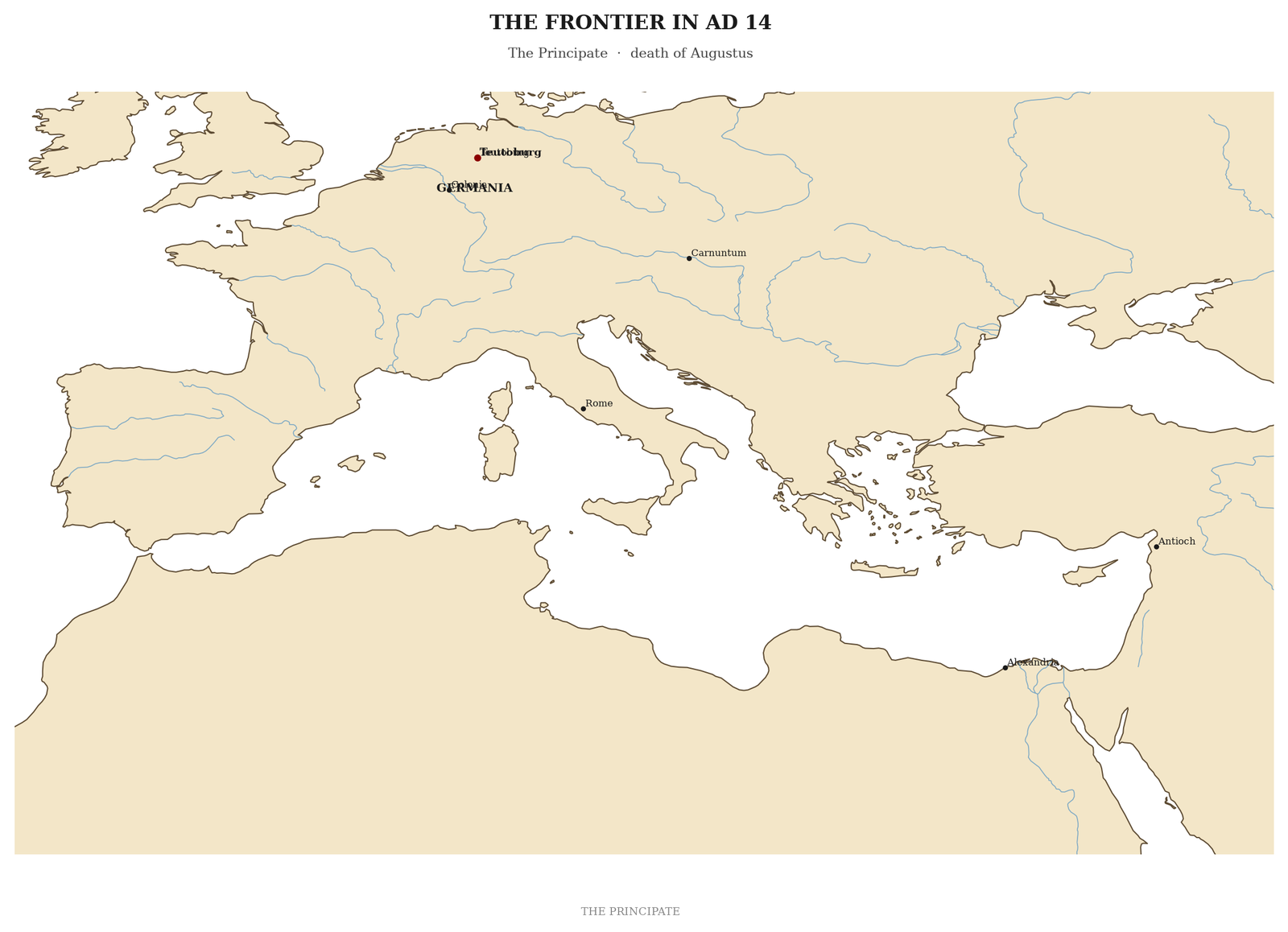
AD 9.
A limit.
Publius Quinctilius Varus, a man of the regime — connections, a daughter of Agrippa’s line in his story, the kind of aristocrat the new order uses — is in Germany with three legions. The seventeenth, the eighteenth, the nineteenth. He is trying to turn a forest into a province. Courts. Taxes. The assumption that the Augustan peace is a solvent that works on every wood.
It does not.
Arminius — a Cheruscan who knows Roman service from the inside — leads him into a trap in the Teutoburg country. Three eagles go down. The numbers are retired like a scar. We do not have a survivor’s film. We have Dio, Velleius, Tacitus later, archaeology in a German bog, and a Roman shock that is not folklore.
Suetonius says Augustus did not cut his hair or shave for months, and that he would beat his head against a door and cry out for the legions.
Maybe the gesture is too good. Later tradition loves a line.
The policy that follows is not a line.
The Rhine becomes a fact instead of a temporary camp on the way to the Elbe.
Tiberius and Germanicus will still campaign. There will still be revenge, still be drowned men and burned villages, still be a recovered eagle or two to hang in a temple. The larger dream — a Germany that looks like Gaul, a frontier far to the east — is wounded in a way the Res Gestae does not advertise.
The principate is a machine for monopoly at the center.
It is not a machine for infinite edges.
That matters to the system, not only to military history.
A monarchy in republican clothing sells peace. Peace can mean victory. It can also mean a river you stop asking the gods to move.
After AD 9 the costume has to include a word it dislikes: enough.
Enough legions to hold, not enough to dissolve every forest.
Enough taxation to pay the eagles, not so much that the center looks hungry.
Enough glory on the wall, and a silence where three numbers used to be.
If you want a place where the official mouth and the world disagree, stand between the Res Gestae and the Kalkriese soil.
The wall has victories.
The soil has rust.
August, AD 14.
He dies at Nola, on the road in Campania, seventy-five years old, forty-odd years after the first settlement, more than half a century after he became Caesar’s heir. Suetonius gives you last words about a play and a round of applause. Maybe. Label it as the kind of ending writers like.
The body is what it is.
The machine is what we have been walking through.
Tiberius is already holding the relevant powers. That was the point of AD 4 and the years after. The Senate will be asked to do what the Senate does: make the continuation look like a request.
Tacitus opens the Annals here, and he is not kind.
He says the Romans preferred the present safety to the old dangerous liberty. He says the great houses were gone or tamed. He says Augustus had drawn into himself the functions of Senate, magistrates, and laws. He says the younger men had been born after the Actium age and knew only the princeps.
You do not have to take Tacitus’s temperature as the only weather.
He is writing under later emperors, with a senator’s memory of humiliations Augustus did not personally inflict. Velleius, closer to Tiberius, writes a smoother morning. Dio, later still, gives you institutional diagrams in the costume of narrative. Suetonius gives you the door and the hair and the cry for Varus.
You do have to hear Tacitus’s structural claim, because it is the claim of a man who has watched the costume from inside the Senate’s grandchildren.
The functions of Senate, magistrates, and laws drawn into one body.
A generation that cannot remember the argument.
Safety preferred to a liberty that had become a civil-war word.
The disguise lasts, first, because the audience changes.
A man who remembered Cicero’s Rome could call the principate a costume.
A man born in 10 BC cannot remember the play before the costume.
He can only remember the quiet.
What does Tiberius inherit, in the concrete?
He inherits the levers of 23 BC — tribunician power, greater command — already shared into his hands.
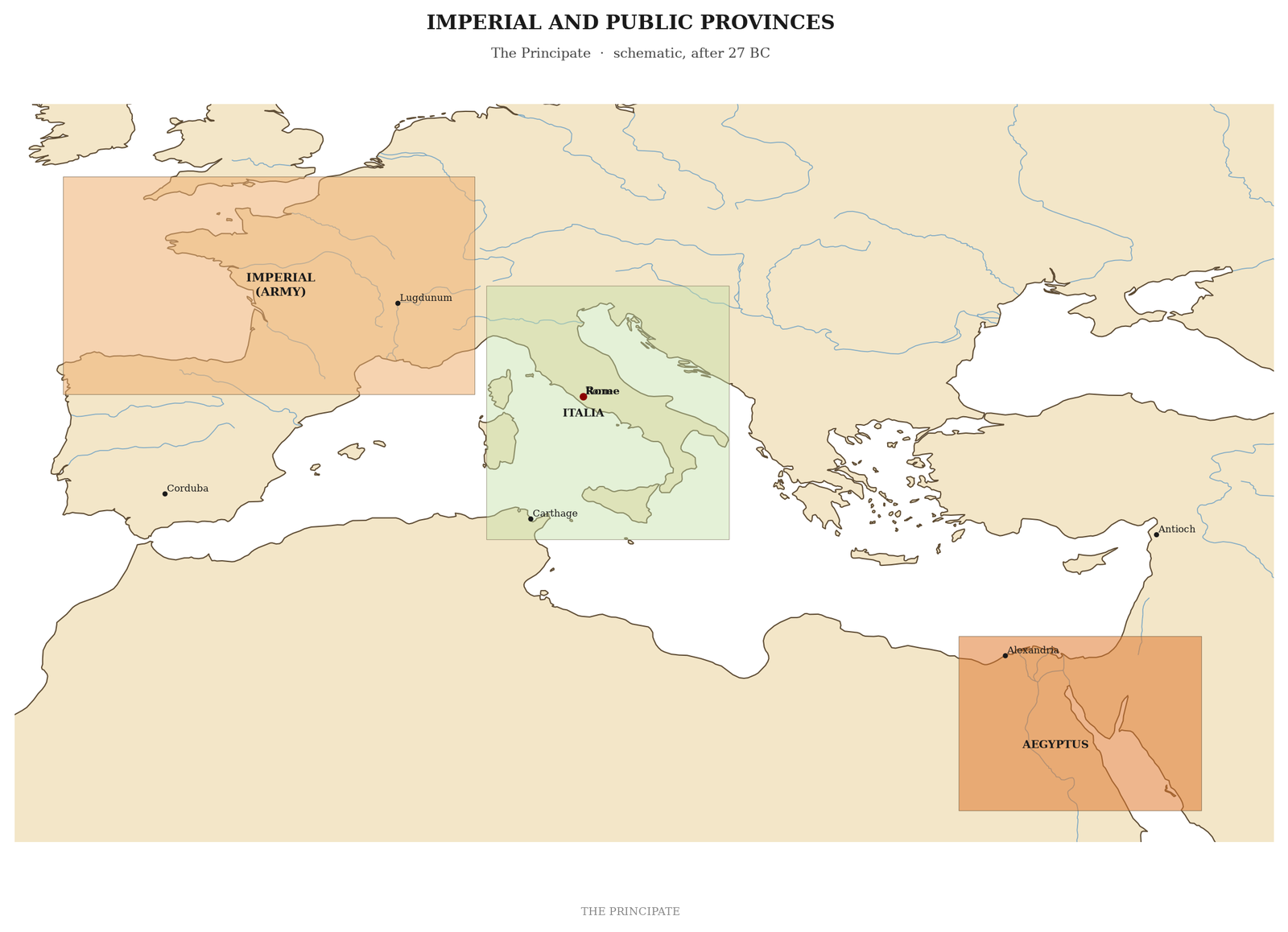
He inherits the map: public provinces for honor, imperial provinces for eagles, Egypt locked.
He inherits about twenty-five legions and the wound of three.
He inherits a grain system that must not fail in a year he is mourning.
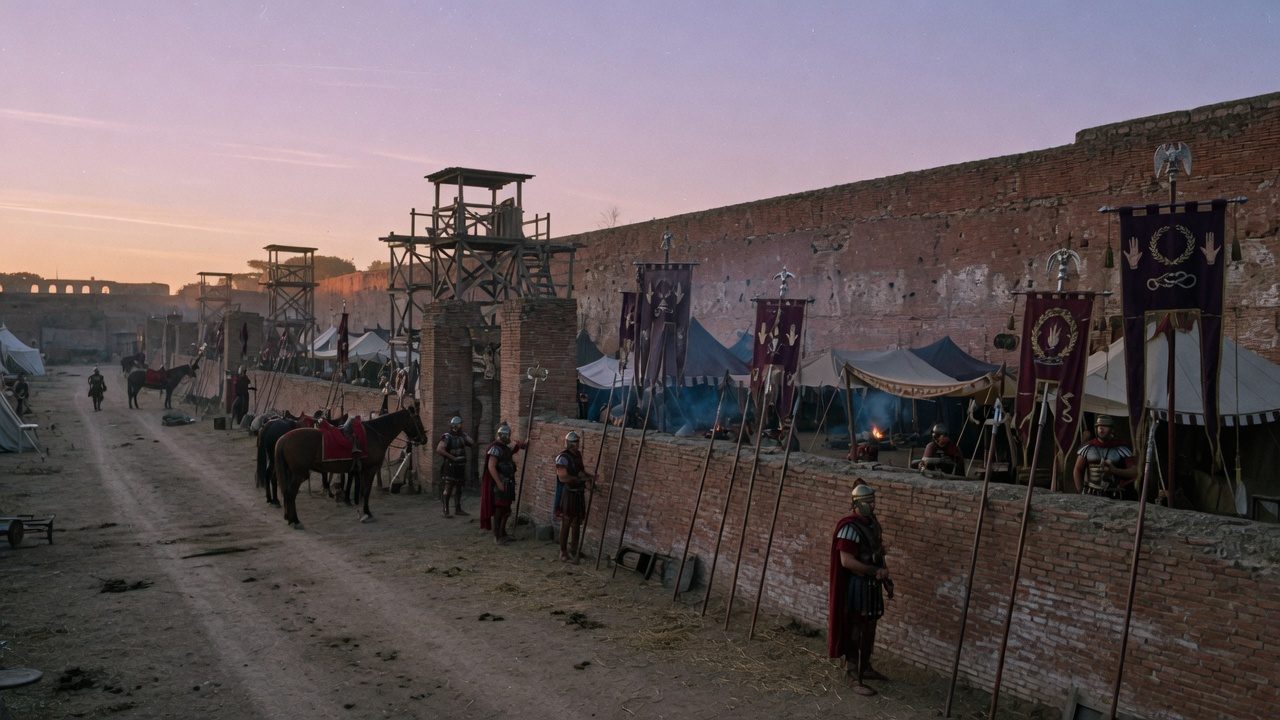
He inherits praetorian cohorts that are not yet in one camp, and he will, through Sejanus, put them in one camp, which is a decision the founder did not have to live with.
He inherits a Senate that knows how to vote yes and still wants to be respected for it.
He inherits a household that knows the files.
He inherits a moral language his predecessor’s own daughter cracked.
He inherits a wall of words he cannot match. Tiberius is a grim competent, not a brand.
He inherits the unsolved problem, now with Germanicus shining beside him like a reminder that the people can love a different body.
He inherits, above all, the need to keep saying he does not want it.
Augustus wanted it, and spent a life pretending not to want pieces of it.
Tiberius may, in some private weather, actually not want it.
The machine does not care.
The chair is not allowed to be empty.
Watch the first months of the new reign if you want the costume under a different actor.
Tiberius hesitates in public. He talks about the burden. He asks the Senate to share. Tacitus treats this as acting. Velleius treats it as virtue. Both may be looking at a man who is trapped between the founder’s script and his own distaste for the theater.
The eagles on the Rhine and Danube mutiny. Pay. Discharge. The shock of a dead paymaster. Germanicus on the German front, Drusus on the Pannonian, have to go and put the fire out with a mix of theater, concession, and blood. Tacitus writes those scenes as if the army were a chorus that has learned the plot: we made you; pay us; do not pretend the Senate is our mother.
That mutiny is a product review.
The army has understood the real constitution better than the Senate. The state is a person. When the person dies, the contract is briefly blank. Fill the blank, or the eagles will fill it for you.
Once Tiberius is the person, the blank is filled.
The Republic does not rush back into the gap.
There is no Republic in the gap. There is only weather.
The face on the coin changes.
Not all at once, not everywhere, not without piety toward the dead man who is now a god. The deified Augustus becomes a temple, a priesthood, a reason. Godhood, delayed in Italy while he lived, arrives on schedule when it is useful to the heir.
That is the last tool in the box, and it only works after the funeral.
A king who becomes a god while breathing looks eastern, and dangerous.
A father who becomes a god when the son needs him looks like piety.
The principate’s religious care is, among other things, a timetable.
Why did the disguise last?
Not because nobody noticed.
People noticed. Tacitus noticed later, in a long literary flinch. Senators noticed in the moment and chose dinner. Soldiers noticed and asked who paid. Provincials noticed a name on an oath and a tax. The urban crowd noticed bread.
The disguise lasted because it did work that a naked crown could not do as cheaply.
It let the senatorial class keep its staircase and its funerals.
It let Italian towns send their sons into a club that still looked like the club.
It let the word libertas stay in the language, thinner, still useful.
It let the city avoid the particular shame of having a king after all that schoolboy history about expelling kings.
It let the provinces have one address.
It let the eagles have one paymaster.
It let peace — meaning no more Italian civil wars this decade — become a habit that felt like nature.
And it let the founder write the story on a wall so that the habit would have a scripture.
Syme’s cold sentence still sits here at the end, where it belongs. A new elite. Not only a new man. Municipal Italy, officers, families that chose the winning civil war and were paid in the right to sit under a ceiling. The disguise lasts because a class is wearing it, not only a face.
When that class’s grandchildren know no other weather, the costume is just the climate.
Could they have said king and saved themselves the trouble?
They could have tried. Caesar’s death is a strong hint about the price.
Could they have actually restored the Republic — the competitive oligarchy with real elections and real provincial armies in senatorial hands?
They could have tried. The last generation that tried it produced the corpses the principate walked in on.
The machine is what you build when both honest options have a recent body count.
That does not make it gentle.
It makes it likely.
Likely things last.
By AD 14 the edges of the likely thing are visible.
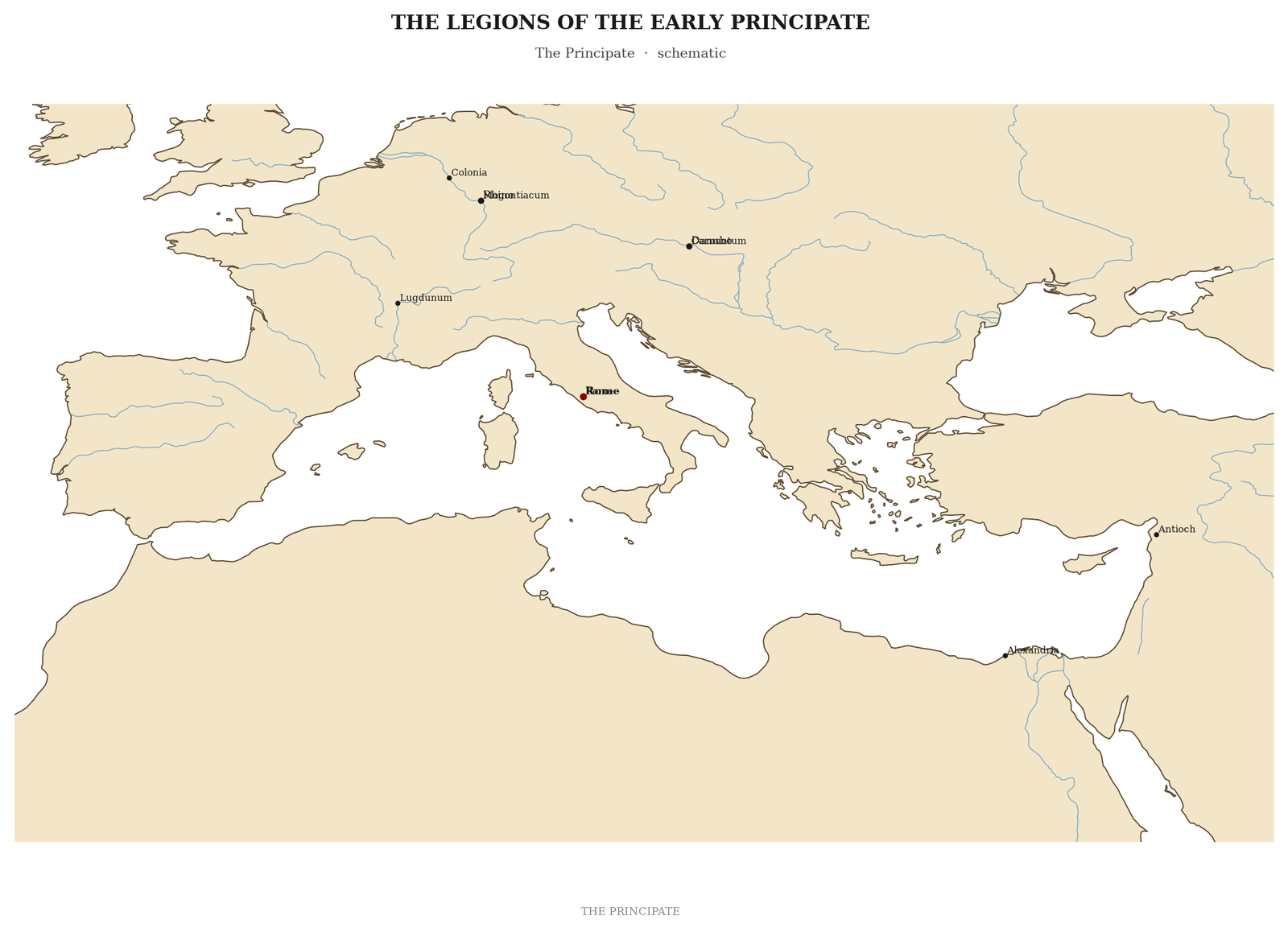
Rhine. Danube. A Syria that faces Parthia with diplomacy and four legions. An Africa that sends wheat. An Egypt that sends wheat and is not a senator’s toy. A Spain that has finally, after years of ugly war, gone quieter. No Britain yet. A Germany that has taught a limit.
Inside the edges: a city of marble claims, a Senate that meets, elections that happen, a household that files, a guard that waits, a law about marriage, a wall of words.
That is the principate.
Not a day when the Republic was abolished.
A set of Tuesdays when the Republic was employed.
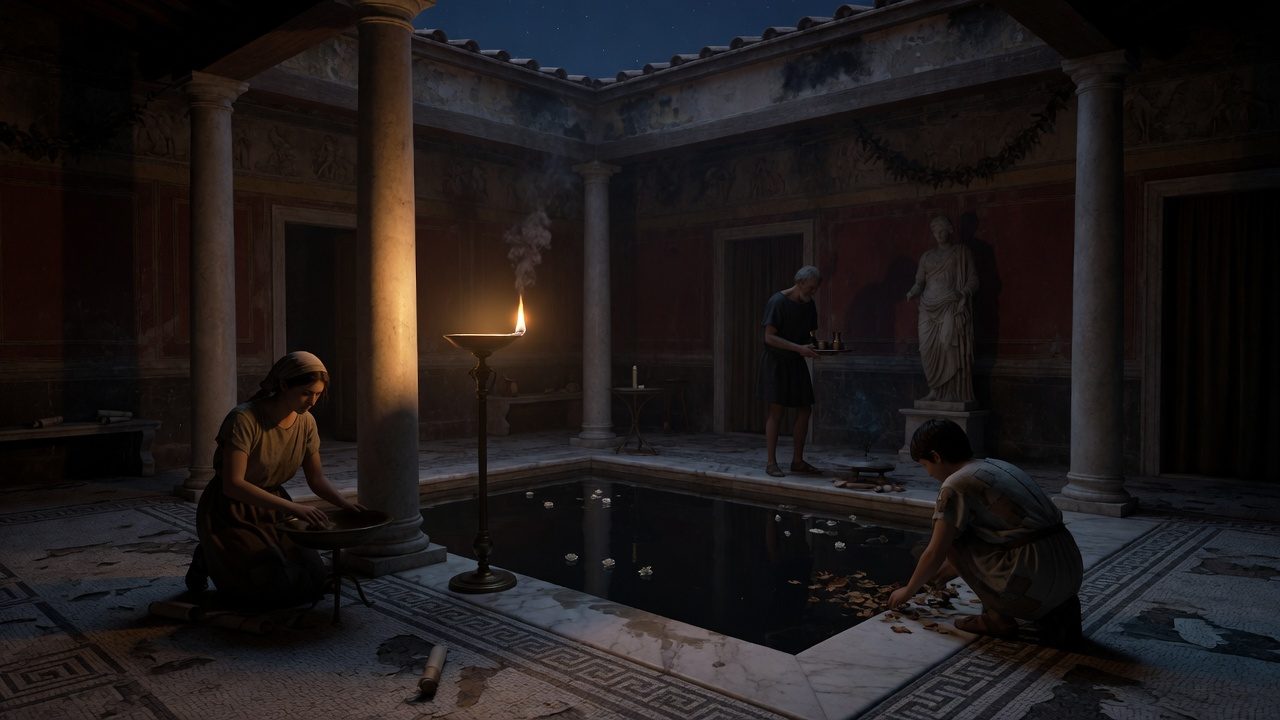
The new senator from the first block is dead.
His son is in the house now. Maybe a consul in some quiet year of Tiberius. He has never heard Cicero speak. He has never seen a civil war in the Forum. He has seen a Germanicus. He has seen a coin. He has walked past the Ara Pacis so many times he does not look up.
He believes, if he is loyal, that the commonwealth was restored in his father’s youth.
He believes, if he is intelligent, that he should not say so in a way that counts the eagles out loud.
Both beliefs can live in one head.
That is still how the system lasts.
The chair will empty again.
It will empty badly, sometimes. Caligula. Claudius pulled from behind a curtain in a later story. Nero. A year when the eagles shop for a person. Then other families. Then the habit of calling the person imperator until our word emperor has no shame left in it.
The clothing will thin.
The monarchy will become willing to be looked at.
But the first cut — the cut of 27 and 23 BC, the word princeps, the refusal of rex, the Senate kept open like a beautiful shop, the household doing the books — that cut remains the reason Rome’s empire does not begin with a coronation scene you can film in one shot.
It begins with a rearrangement.
Furniture moving in a room that is still called the same room.
Stand last at the wall.
The letters are holes, in some of the copies, where bronze studs have been robbed. You can still follow the columns. I restored. I gave. I refused. I built.
A press release that outlived the press.
Then look at the objects we have carried.
A law about other people’s houses.
A coin with one face.
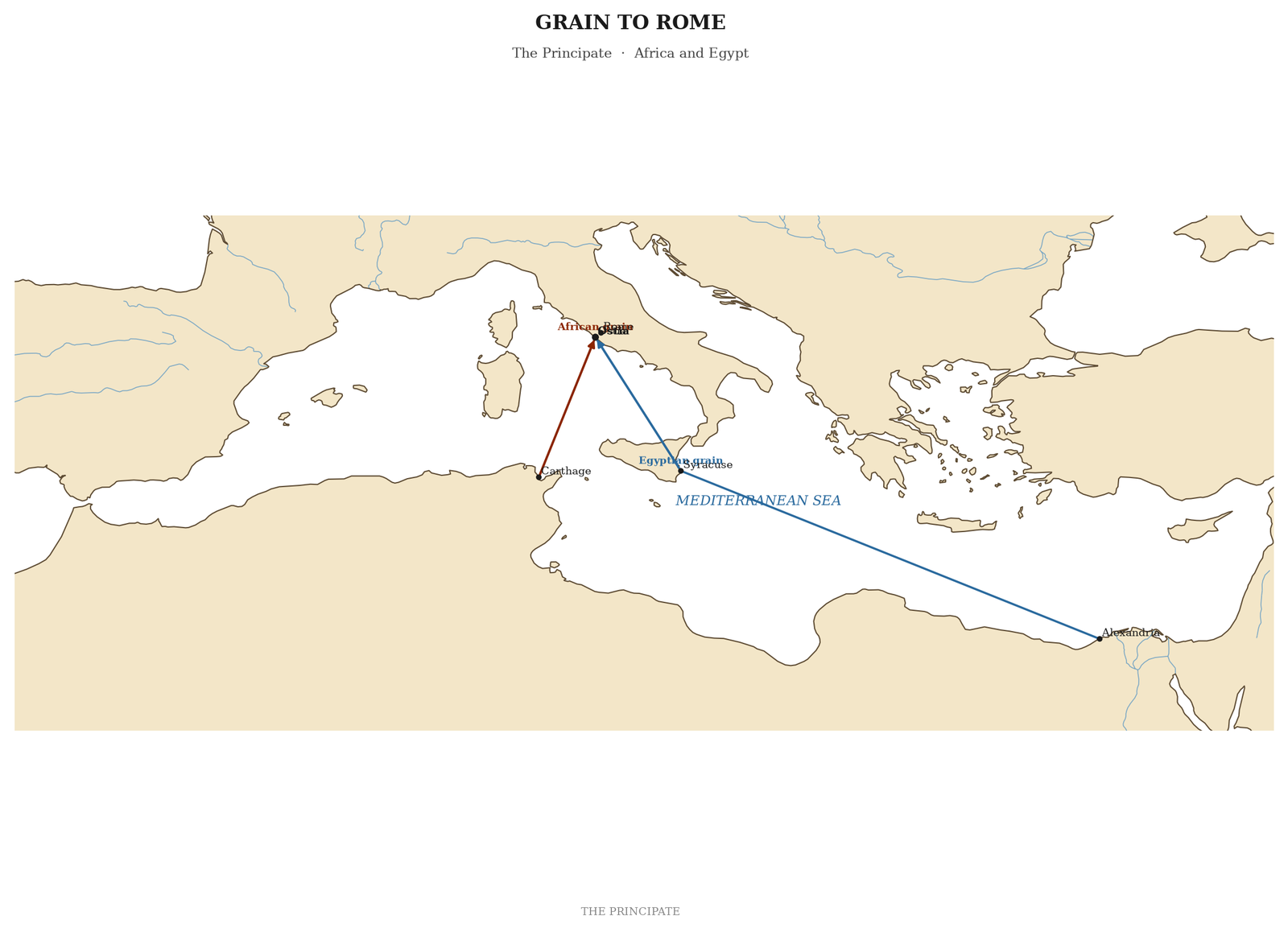
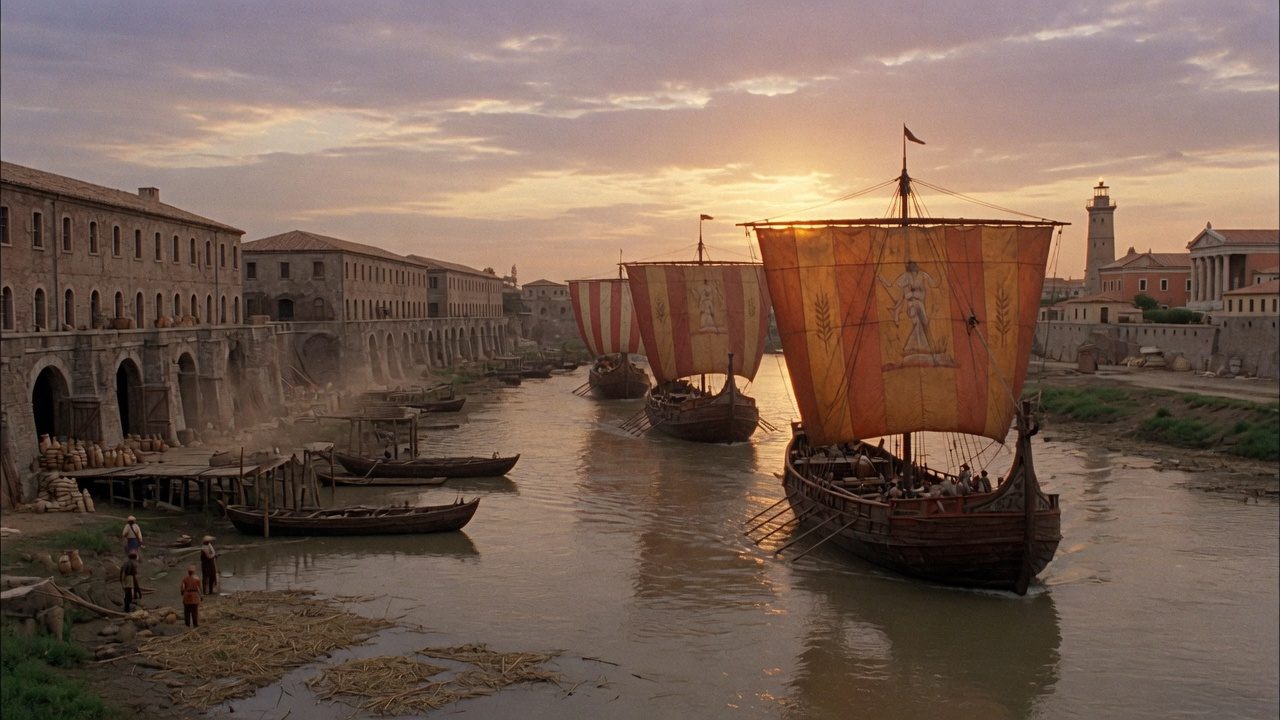
A grain ship at Ostia.
A camp that is not yet a camp, then is.
A chair that cannot admit it is a throne.
A forest that said enough.
A Senate that still meets.
If you can hold all of those in one view, you know how the principate worked.
Not as a miracle.
As a machine.
Monarchy in republican clothing.
The clothing was expensive.
The monarchy fit.
First citizen.
Not king.
The difference was a language.
The sameness was a payroll.
Between the language and the payroll, a world ran for a long time.
That is the system.
That is the film.
The man who built it is a god on a wall.
The machine does not require him to be a god.
It requires the next pair of hands, and the next, and a city that has learned to call the arrangement peace.
The procession does not move.
We can.
End Block D