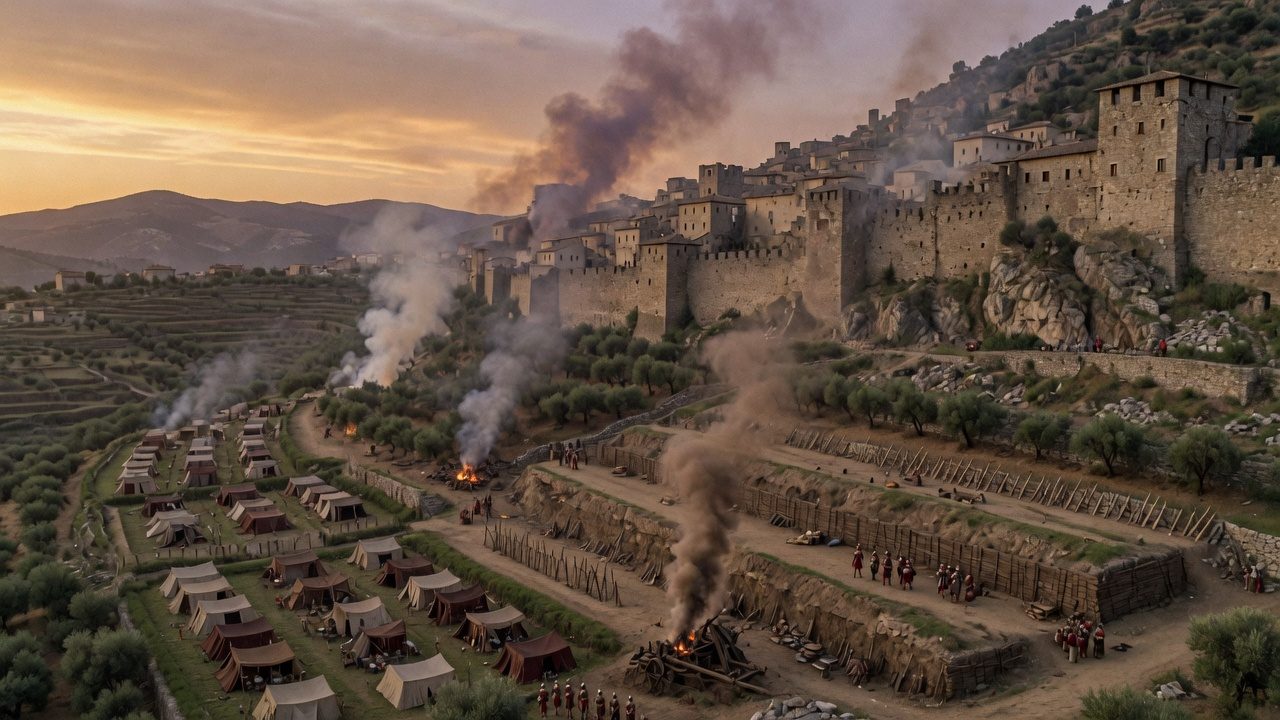
- D8 timeline closer — last five minutes of the long cut
Social War mechanics
If you only remember “the Italians wanted citizenship,” you will not understand why Sulla’s later colonies feel like revenge, or why Samnites are still in arms at the Colline Gate ten years after the first treaties.
Start with the deal as it actually ran.
An allied community in Italy is not a suburb. It has its own magistrates, its own census, its own army levy. When Rome calls, the socii send troops under their own officers, brigaded with Roman legions. They take casualties at Numantia, in Gaul, in Africa. They watch Roman commanders put imperator on a coin. They are subject to the weight of Roman officials on the roads. They cannot vote in the Campus Martius. They cannot stand for the consulship. They can die for a city that still calls them foreigners when the census tablet comes out.
For a long time the deal is tolerated because it is old, and because local elites get protection and a share of the plunder. Then two things change.
The empire gets richer. The difference between a Roman and an ally becomes a difference in access to that richness — contracts, grain, status in a courtroom. And the Gracchan age puts land and citizenship on the table as things you can fight about in the city, not only at the edge of the map.
Livius Drusus in 91 tries to pass an Italian citizenship bill inside a larger conservative package. He is killed. The Italians who had bet on a law now bet on a war.
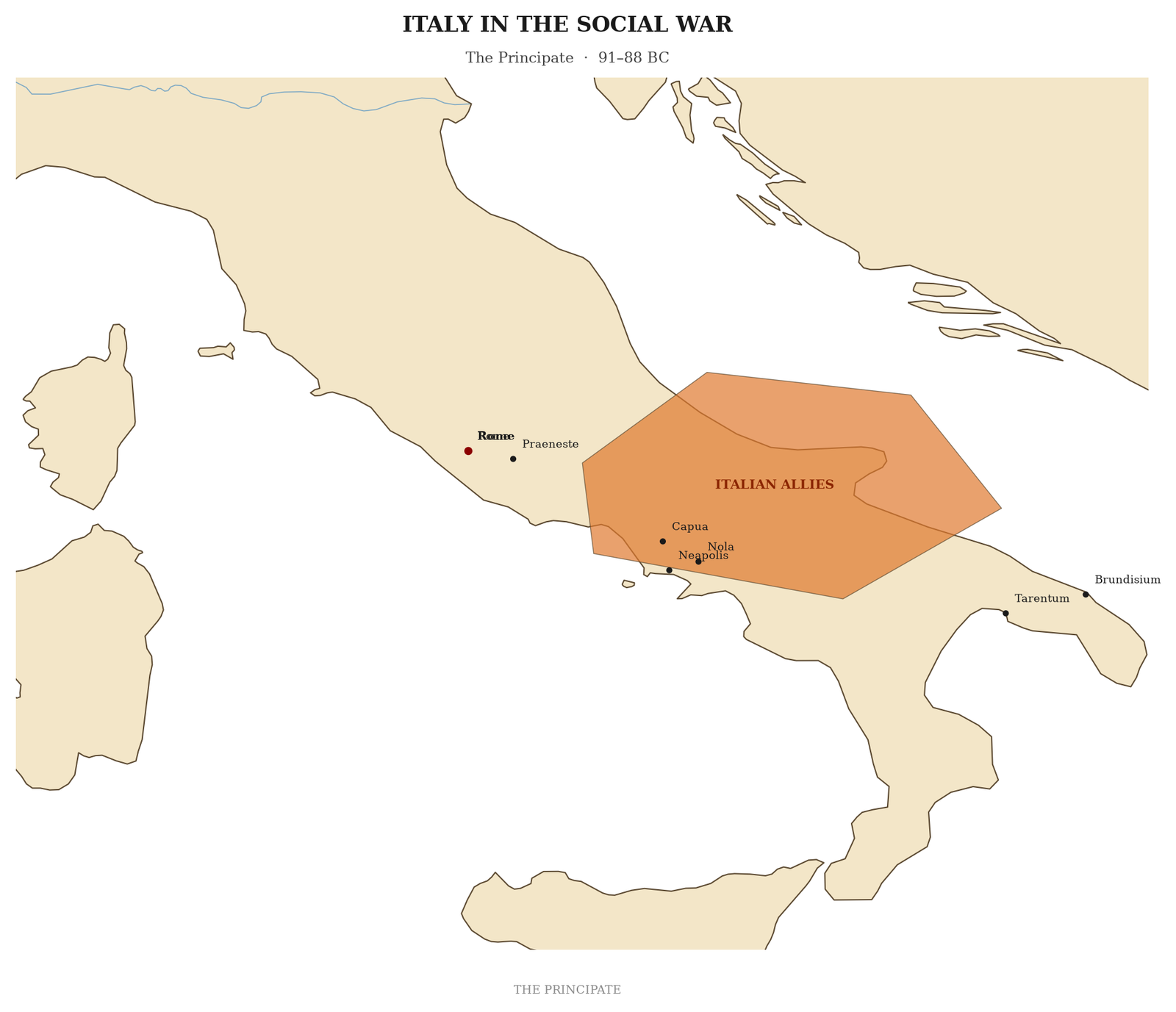
They do not fight as a mob. They build a counter-Rome. Corfinium, in the central Apennines, is renamed Italica. There is a senate of a few hundred. Two consuls, in imitation. Coinage. A war plan with a northern theater — Marsi, Paeligni, Picene country — and a southern theater — Samnites, Hirpini, Lucani, Campanian edges. Rome has to learn, in a hurry, to fight on two Italian fronts against men who already know Roman drill.
Rome’s first year is ugly. Consuls die. Towns defect. The Via Valeria is not safe. Then the political brain, late as always, starts to work. The lex Iulia of 90 offers citizenship to communities that have stayed loyal, or that lay down arms on terms. The lex Plautia Papiria in 89 lets individuals in allied cities register with a praetor. Other measures handle Cisalpine communities. This is not kindness. It is a wedge. Split the Italian coalition. Give the elites what they wanted. Keep fighting the people for whom the word “Rome” now means a burned town.
Many take it. The war’s meaning changes. It is no longer, everywhere, a war for a franchise. It is a war about who lost family to Roman fire, and who will be on which side when the next Roman faction needs troops.
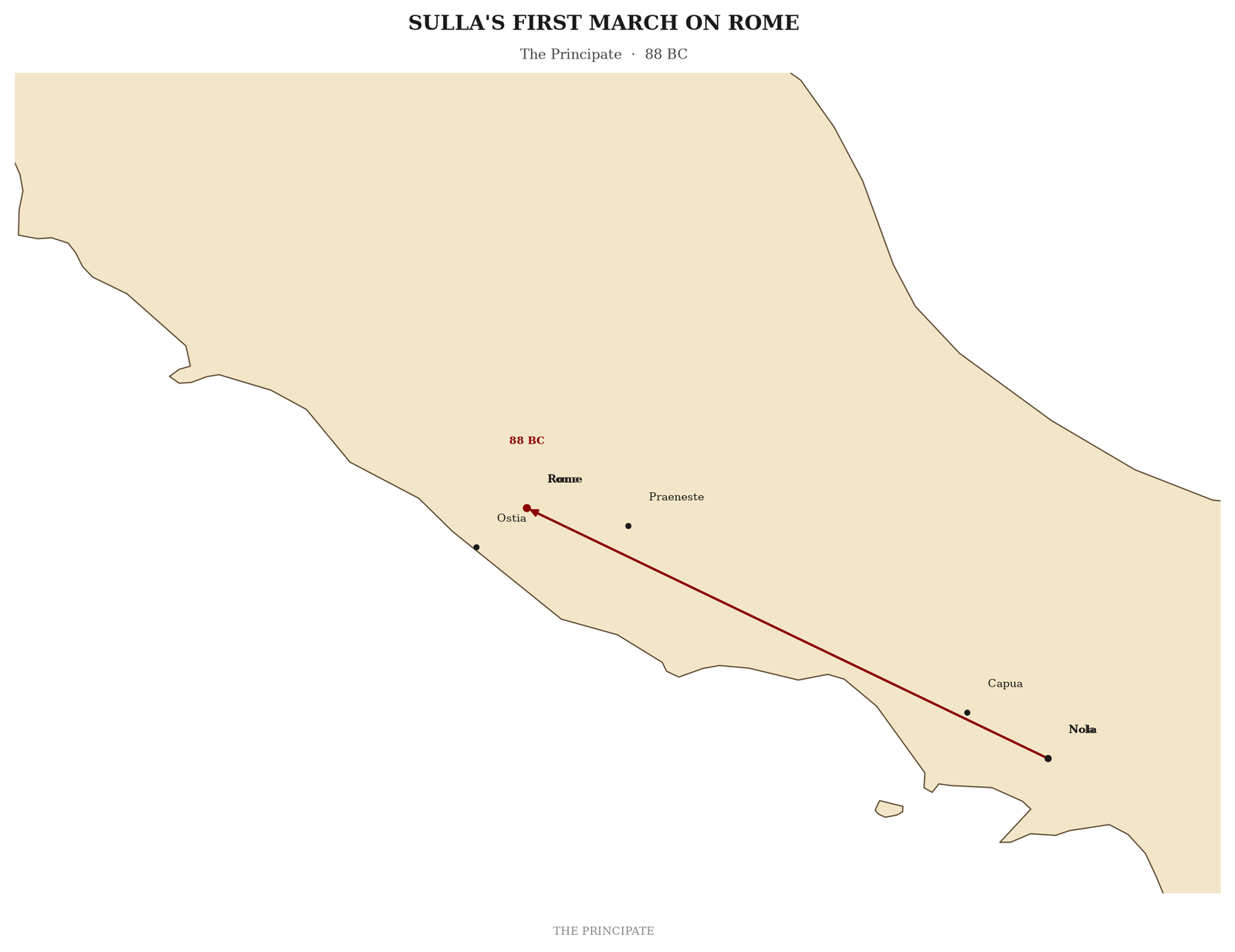
Sulla’s southern command sits in that second war. Aeclanum burns. Samnite strongholds are reduced. Nola still holds out into his consulship — that is why his army is there in 88, close enough to Rome to walk. The men in those cohorts have been killing Italians who look like their cousins. They have also been promised, implicitly, that the next campaign is Asia, where the money is.
When we say “Social War veterans followed Sulla,” we are saying: men trained in a civil war that still used the word ally, then invited to a civil war that did not bother.
The Samnites who appear at the Colline Gate in 82 are not confused. They are finishing an argument that started in 91. Sulla’s colonies in their country are his answer. Citizenship without land, land without the old owners — that is the mechanics, all the way down.
How a march on Rome works
Forget the movie version: a villain points at a capital and a faceless army nods.
A march on Rome in 88 is a legal problem, a payroll problem, and a taboo problem. Sulla solves all three in order, or he does not arrive.
First, the taboo.
Rome has a sacred city boundary, the pomerium. Inside it, a commander’s military power is supposed to fall off him like a wet cloak. He becomes a magistrate among citizens. An army under arms inside that line is a confession that the city is being treated as a foreign town. Everyone in Sulla’s officer corps knows this. That is why the senior men, most of them, refuse. They are not suddenly kind. They are not ready to be the first names in a new crime.
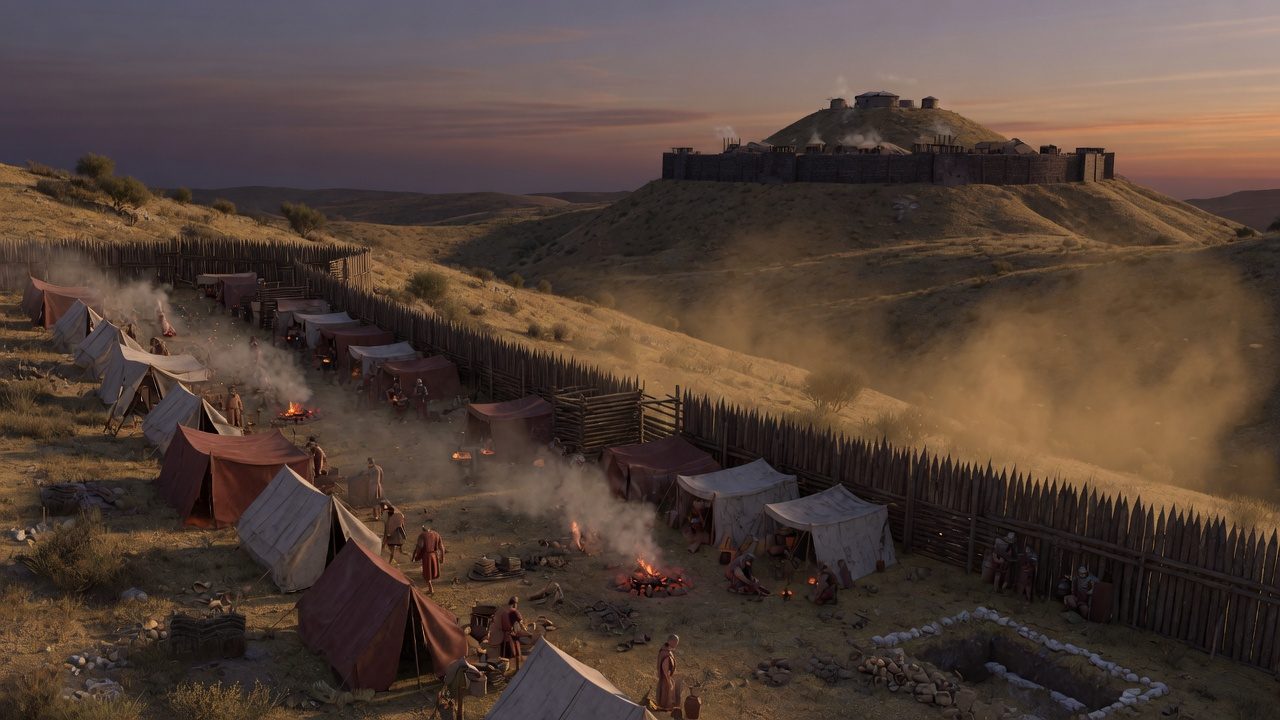
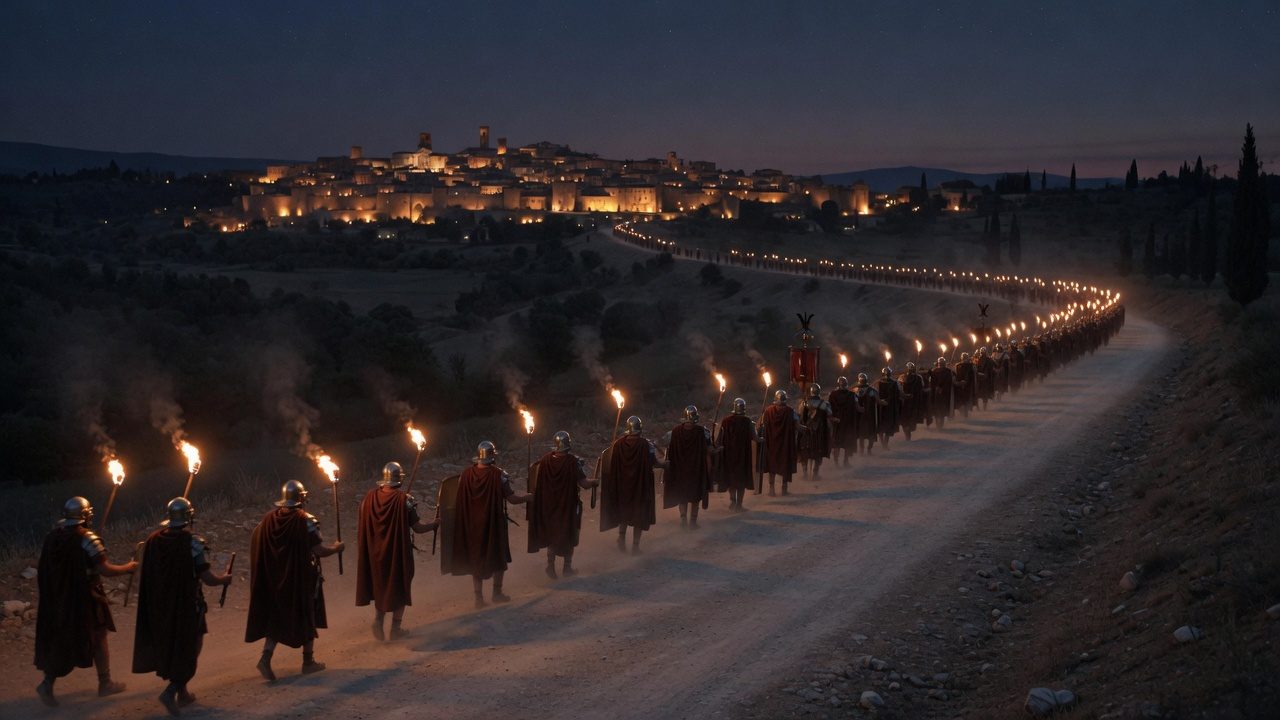
Sulla does not need them. He needs the centurions and the rank. He calls an assembly at Nola, in the still-smoldering edge of the Social War. He tells them the truth that is also a bribe: Marius and Sulpicius have stolen the Mithridatic command. Stolen from him, which means stolen from the army that expected Asian cities, Asian fines, Asian slaves. If they stay legal, they stay poor. If they follow him, they are criminals with a future.
Second, the payroll.
Late-Republican soldiers are not unpaid patriots. From Marius onward the general is the man who finds them land and donatives. The Senate is a rumor. Sulla has been their winning general in the south. He is standing in front of them. Marius is a name in the Forum. The choice is not abstract.
Third, the road.
Nola to Rome is not a season’s march. It is days. The Via Latina and the approaches from Campania are roads these men already know. Speed is part of the law-breaking. If you give the city time, the city raises a scratch force and a story about tyrants. If you arrive while the story is still being drafted, you are a fact.
What do you do when you arrive?
You take the gates that matter. You occupy the places assemblies happen. You kill or drive out the authors of the law that robbed you. You do not, in 88, try to rebuild the whole constitution — Sulla does not yet have the stomach or the leisure. You pass enough decrees to make your command look legal again. You leave a colleague, a praetor, a hope. You take the army east, because the army came for Asia, not for street-fighting.
That last move is why 88 is a lesson and 82 is a regime.
A march on Rome works when the general and the ranks have the same enemy in the city. It fails, later, for men who forget the payroll. It becomes a habit when the first man who does it not only lives, but comes home richer, writes memoirs, and dies in bed.
Caesar at the Rubicon is this mechanism with better prose. Octavian in 43 is this mechanism with a younger face. They are both walking on Sulla’s road survey.
The pomerium is still there. It just does not mean what it meant in 89.
Mithridates as a Hellenistic problem
It is easy to cast Mithridates as a cartoon who hates Romans for the sport of it. He is more interesting, and more typical.
He is a Hellenistic king. That means his court is a mix of Macedonian royal habit, Greek city diplomacy, and local Anatolian and Iranian power. He claims Alexander the way every eastern dynasty claims Alexander. He murders his way through family because that is how these houses keep a throne for forty years. He speaks many languages. He is interested in poisons, in the way a man who expects assassination becomes a hobbyist. Later legend will make him drink toxins for breakfast. Label the breakfast. Keep the fear.
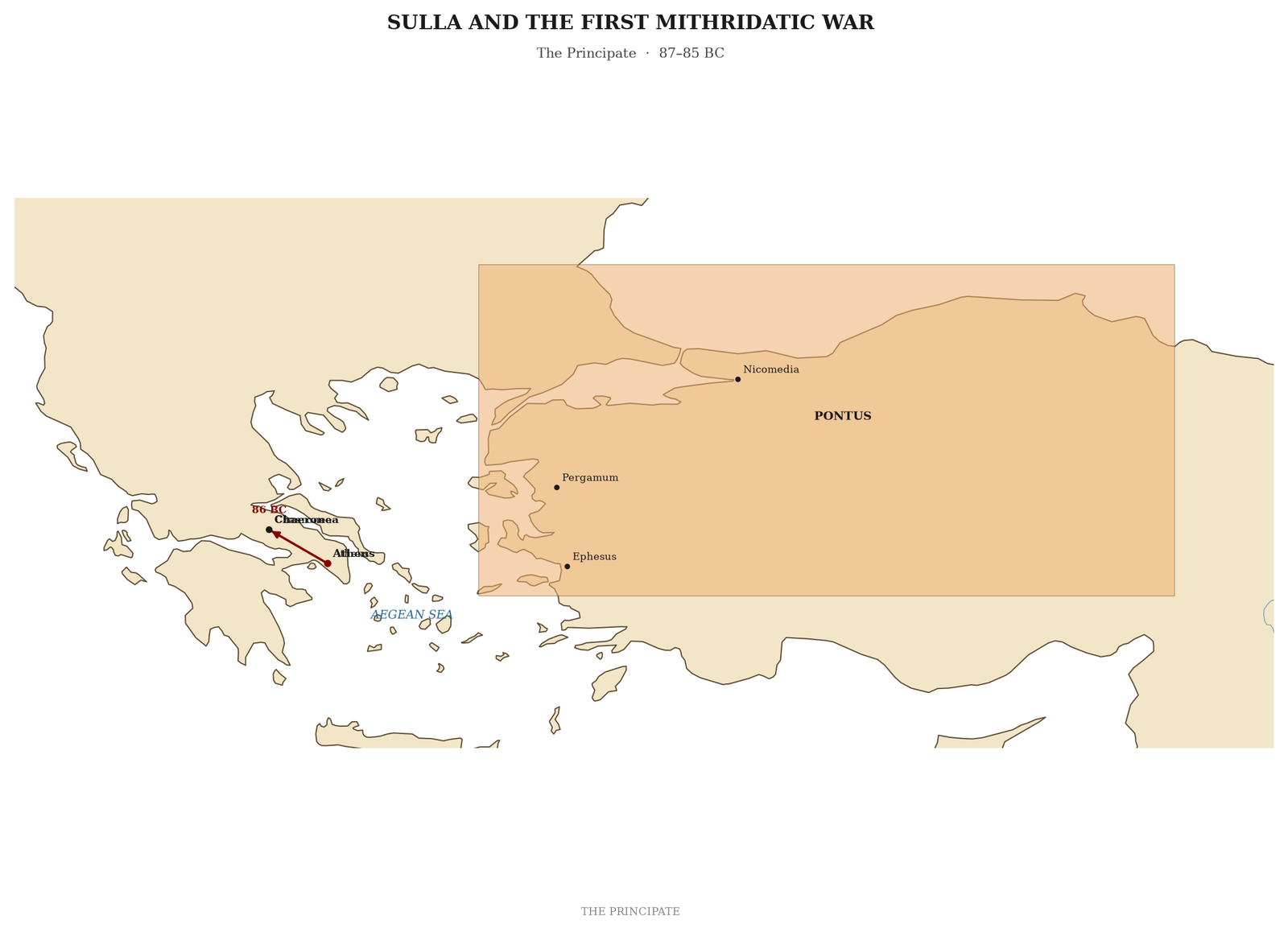
His real project is not “destroy Italy.” His project is to be the person who organizes the Black Sea and Anatolia while Rome is busy being corrupt and distracted. Cappadocia. Bithynia. The Greek cities of Asia. Colchis. The Crimea. He is building a kingdom the size of a Roman problem.
Rome, for him, is a system of governors and tax companies that can be bought, sued, or surprised. The 90s make his bet look smart. Roman commanders come out, restore a client, take a wreath, and leave. Sulla himself, in Cilicia, is one of those commanders. Then the Social War locks Italy’s best armies at home. Mithridates moves.
The massacre of 88 is the tell. It is not a battlefield. It is an order sent to cities: on one day, kill the Romans and Italians among you. Some cities obey with energy. Some obey because they are afraid of the Pontic army at the door. The Roman business class in Asia — the people Cicero’s later audiences still remember as the wounded order of knights — is gutted. This is why the command is worth a civil war in Rome. It is revenge, it is a rescue of credit, and it is a treasure house.
Once Sulla is in Greece, Mithridates fights the way a Hellenistic king fights. Generals, not the king, in the first line. Archelaus in Piraeus and Boeotia. Large mixed armies. Scythed chariots, which look terrifying and die in ditches. Attempts to hold famous Greek names — Athens — for the poster of liberation.
Sulla fights him the way a late-Republican Roman fights anyone: siege, then pitched battle, then a political settlement that leaves the king alive if the Roman has a more urgent enemy at home. The Treaty of Dardanus is shocking only if you thought this was a war of annihilation. It is a war of calendar. Sulla’s calendar says Italy.
Mithridates will be Rome’s problem again. Lucullus will spend years in the mountains after him. Pompey will finish the file and hold a triumph that makes Sulla’s eastern chapter look like a preface. That is the Hellenistic pattern too. These kingdoms rarely die in the first war. They die when Rome finally sends a man who is not in a hurry to catch a boat west.
So when you see a map of Pontus, do not think “villain’s lair.” Think: the last big Hellenistic state that still had the nerve to test whether Rome was an empire or a racket.
In 88, it was both. Sulla used the empire half to pay for the racket half.
The Sullan Senate
If you walk into the Senate of the 70s and 60s — Cicero’s Senate, the Senate that will later stare at Catiline’s empty benches — you are walking into a room Sulla remodeled.
Before him the hereditary Senate is smaller, something on the order of three hundred, filled by custom from men who have held office, policed by censors, dominated by a few families who know how to wait. After him the target number is about six hundred. The new seats are not a civic education program. They are a victory roll.
Who comes in?
His officers. Equestrians who financed the right side. Italians from towns that opened on time. Men who would never have smelled the Curia if the old filter had held. Some of them will become the respectable fathers of the next age. Some of them are here because they are terrifying and he prefers them inside the tent.
He does something else that looks technical and is not. He restocks the jury courts with senators. For a generation the big extortion and corruption courts had been a battlefield between Senate and knights. C. Gracchus had given the knights the benches. Sulla gives them back to the Senate — his Senate. So the same enlarged house that owes him its size now sits in judgment on governors, which is to say on itself and on its enemies.
He pairs this with the attack on the tribunate. A tribune who cannot take legislation straight to the people, and who is banned from the rest of the cursus, is not the tribune of the Gracchi or of Sulpicius. He is a local official with a bad career path. That is the point. The Senate he has packed is not supposed to be outflanked by a crowd in the Forum.
Does it work?
For a few years, yes, in the way a nailed door works. Then Pompey and Crassus, consuls in 70, restore tribunician power because they need popular tools. The courts get mixed again. The Senate remains large. The new families remain. What does not return is the old mystique — the idea that this room is old weather, not a recent construction site.
Cicero will spend his life talking to this house as if it were the fathers. Sometimes it is. Sometimes it is a Sullan colony in togas. When it fails to stop Caesar, it fails as Sulla’s room, not as Romulus’s.
One more mechanic, because it shows his mind. He ties offices to ages and sequences again. Quaestor, then (if you insist) the rest, then praetor, then consul, with gaps. He has Ofella killed for skipping. He is trying to make sure that nobody else does what Marius did — sit in the consul’s chair like a permanent emergency — and that nobody else does what he did, except him, and he is finished.
A constitution designed by the one man it exempts is not a constitution. It is a ceasefire with tablets.
The Senate of the late Republic is that ceasefire, still in session.
Property as politics
The lists are a legal instrument. They are also a real-estate closing.
When a name goes on the board, the man dies or runs. The property does not run. It falls to the state, which is to say to the dictator’s auction. Land, townhouses, furniture, slaves, shops. Buyers appear who have cash and no smell of loyalty problems. Prices are not those of a free market. They are those of a market where bidding too honestly can look like sympathy for the dead.
Crassus becomes the proverb. He will later be the richest man in Rome, the backer of Caesar, the fool of Carrhae. His fortune’s dark floor is here: Sullan confiscations, fire sales, the habit of treating crisis as inventory. You do not need to believe every hostile anecdote to see the structure. Someone had to buy. The people who bought became the people who needed the settlement to last.
Then the colonies.
A veteran given a farm in Etruria is not only being paid. He is being stationed. He is a garrison who plants olives. The previous owner — an Italian community that chose Cinna, or a landlord who chose wrong — is now a problem in someone else’s census. Whole districts change political color because the men who vote there now owe their boundary stones to Sulla.
This is why “Sullan settler” is still a fighting word in the 60s. Catiline will fish in Etruria among the wreckage of those auctions — ruined Sullan veterans and ruined dispossessed, a toxic mix. Cicero’s defense of Sextus Roscius of Ameria, around 80, is a young advocate standing up in this weather and saying: some of these murder charges are just the property grab wearing a toga. He wins. He does not undo the weather.
Asia is the same story in a different currency. The twenty thousand talents on the Greek cities, if we trust Appian’s figure, are not a fine you pull from a mattress. The cities borrow. They borrow from Roman financiers. Interest becomes a second occupation. Lucullus will later try to untangle it and make enemies of the same knights Sulla’s war was supposed to avenge. Property again. Always property.
Even the signet from Bocchus is property as politics. A picture of a prisoner transferred. A claim on credit. Marius understood that, which is why the Capitol monument mattered. Who owns the image of the victory owns the next election.
If you want to know what Sulla built, do not start with the tablets about tribunician procedure. Start with a map of who holds the land in 79, and who holds the mortgages in Asia. The constitution is the caption. The caption is not the picture.
What Felix means
Felix.
In Latin class it gets translated “happy” or “lucky,” and then everyone moves on, as if he had called himself a cheerful man.
He takes it as a name. After the Italian victory, after Praeneste, after the city is his, he becomes Lucius Cornelius Sulla Felix. In Greek he leans into Epaphroditos — favored by Aphrodite, by Venus, the ancestress the Romans like to claim when they want their luck to look like a bloodline. Coins and dedications carry the idea. The twins are Faustus and Fausta. Valeria pulls a thread from his toga to steal a little of it. Fortune at Praeneste sits in a sanctuary on the hill he starved.
This is not a personality quirk. It is a theory of legitimacy.
Marius’s myth is virtus and labor — the new man who saved Italy by being harder than the aristocracy. Sulla cannot use that myth. He is the aristocracy, just the poor room of it. His counter-myth is that the gods keep picking him. The blotched face. The Chaldean in Cappadocia. The liver with a wreath of flesh on it before a Greek battle. The dream in which Bellona, or Ma, puts a thunderbolt in his hand and tells him to strike his enemies. The memoirs dedicated to Lucullus, twenty-two books of I-told-you-so with incense.
If Fortune chose him, then the march on Rome is not treason. It is obedience. The lists are not murders. They are weather. The resignation is not a failure of nerve. It is a lucky man knowing when the luck has done its job.
Other Romans hear this and make a note. You can brand a civil war as piety if you have enough omens and a good engraver.
The omen of the liver, since it is the one people ask about: Plutarch has the seer Postumius inspecting the victim before a battle in the Greek war. The organ shows a crown, a fleshy wreath. The seer tells Sulla to eat the designated parts and go forward; the gods have already set the result. Sulla eats. He goes forward. He wins. In a modern mouth this is folklore. In his mouth it is minutes from a cabinet meeting with the divine.
The mulberry joke belongs here too, not as a smirk. A face like flour on dark fruit is the sort of mark ancient people read. He did not hide it. He turned the whole man into a mark. Lucky. Favored. Stained on purpose.
When he walks away from the dictatorship, Felix is doing a lot of work. A tyrant who stays is afraid. A lucky man can stop. That is the performance.
Caesar will look at the performance and say, in that nasty little pun, that Sulla did not know how to dictate. Caesar’s theory of legitimacy will be different: clemency, speed, the calendar, the crowd. Not Fortune’s favorite. Fortune’s rival.
Two answers to the same problem: how to say that the law broke because it had to.
Sulla’s answer is a surname.
He still has it on the tomb.
The actors belong to the same theology, which is why the Senate never forgave the dinners.
Metrobius. Sorex. The comic professionals a censor would file under luxury. Sulla does not keep them as a secret vice he puts away when the fasces come out. He keeps them in the dictatorship and in Campania. Plutarch says he wrote satyr-plays. Believe the hobby or not. Believe that a man who lived by audiences needed one when the Forum was no longer allowed to talk back.
A general who likes actors is easy to sneer at. A dictator who likes actors is harder. He already knows the whole city is a theater. The lists are a posted program. Felix is a stage name he made the gods underwrite. When he walks through the Forum without a guard, that is a curtain call. When he dies among theater people and a young wife who wanted a thread of his cloak, the last scene is the same as the first: an audience, a marked face, a man who refused to be boring.
The Senate wanted Cincinnatus. It got a producer.
Pronunciation (say it once, stay there)
You will hear these names in more than one mouth. Pick a set and do not wobble on camera.
Sulla — SUL-uh. Not SOO-lah unless you have decided to be pointedly Latinate, in which case stay there for the whole film.
Lucius Cornelius Sulla Felix — LOO-shus kor-NEE-lee-us SUL-uh FAY-liks. Felix as FAY-liks, not “fee-lex.”
Marius — MAR-ee-us.
Mithridates — mith-rih-DAY-teez. Six of Pontus.
Chaeronea — kair-oh-NEE-uh.
Orchomenus — or-KOM-eh-nus.
Praeneste — pry-NEST-ee. Modern Palestrina.
Puteoli — poo-TEE-oh-lee. Modern Pozzuoli.
Jugurtha — joo-GUR-thuh.
Bocchus — BOK-us.
Sulpicius — sul-PISH-us. Publius Sulpicius Rufus.
Cinna — SIN-uh.
Telesinus — tel-eh-SEE-nus.
Metella — meh-TELL-uh.
Numantia — noo-MAN-shee-uh.
Nola — NO-lah.
Dardanus — DAR-duh-nus.
pomerium — poh-MEH-ree-um.
socii — SOH-kee-ee.
rei publicae constituendae — RAY poo-BLI-kai kon-sti-too-EN-dye. Leave air.
Epaphroditos — eh-paf-roh-DEE-tos.
Faustus / Fausta — FOW-stus / FOW-stah.
Ofella — oh-FELL-uh.
If a guest scholar says it differently, let them. You are the host. Consistency is the courtesy.
Timeline closer
A life in dates, said slowly, no decoration.
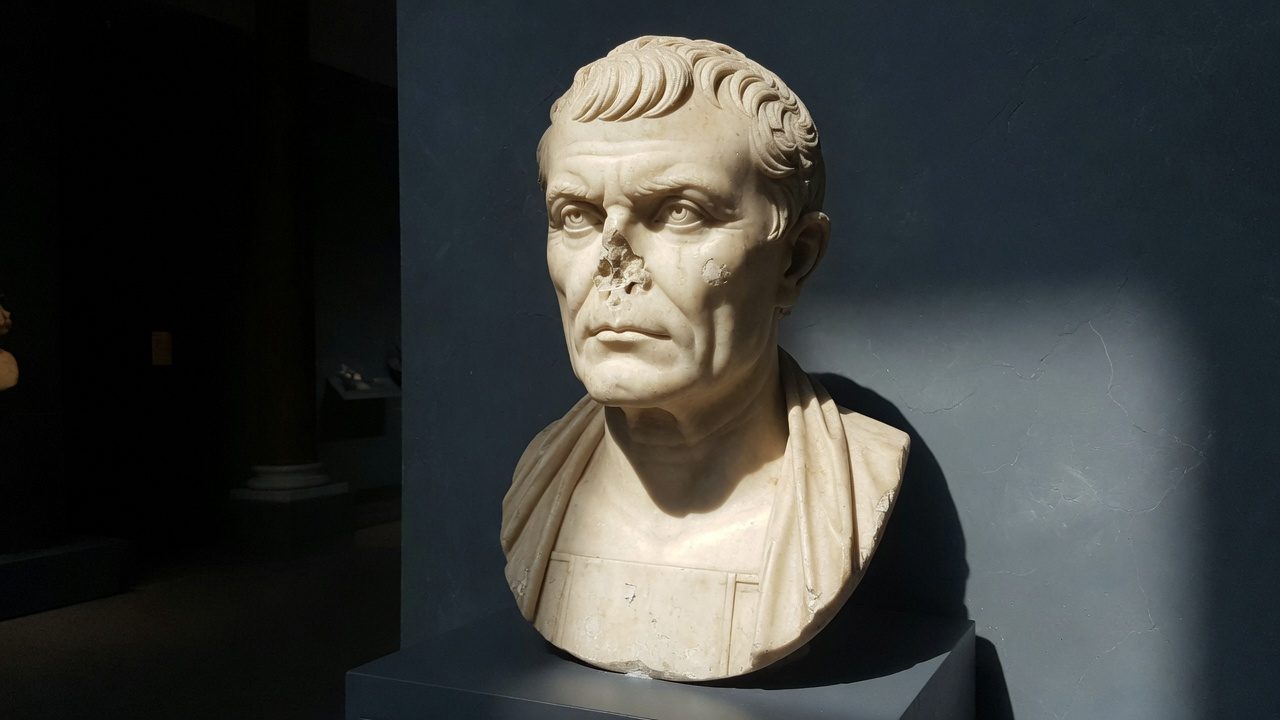
c. 138 BC. Lucius Cornelius Sulla born. Patrician. Thin purse.
134–133. Scipio Aemilianus takes Numantia. Marius is in that camp. Sulla is a child in Rome. The old Cornelian style of war has its last clean monument.
107–105. Sulla quaestor in Africa under Marius. Bocchus betrays Jugurtha into Sulla’s hands. The signet. The rivalry.
104–101. Northern emergency. Sulla serves with Marius, then Catulus. The Cimbri and Teutones are broken. Credit goes, as usual, uphill.
Mid-90s. Praetor after a failed first attempt. Propraetor in Cilicia. Ariobarzanes restored. A Parthian envoy. A Chaldean who tells him he should already be ashamed not to be first.
91–88. Social War. Sulla wins in the south. Consul in 88 with Quintus Pompeius Rufus. Assigned Mithridates.
88. Sulpicius transfers the command to Marius. Sulla’s army at Nola marches on Rome. First consular army to do it. Sulpicius killed. Marius flees. Sulla leaves for the East anyway.
87. Cinna and Marius take the city back. The other terror. Sulla declared a public enemy. He is in front of Athens.
Kalends of March, 86. Athens falls. Marius dies in Rome, in his seventh consulship, the same winter.
86–85. Chaeronea. Orchomenus. Treaty of Dardanus. Mithridates remains a king. Asian cities pay.
83. Sulla lands at Brundisium. Pompey brings private legions. The Italian civil war, second movement.
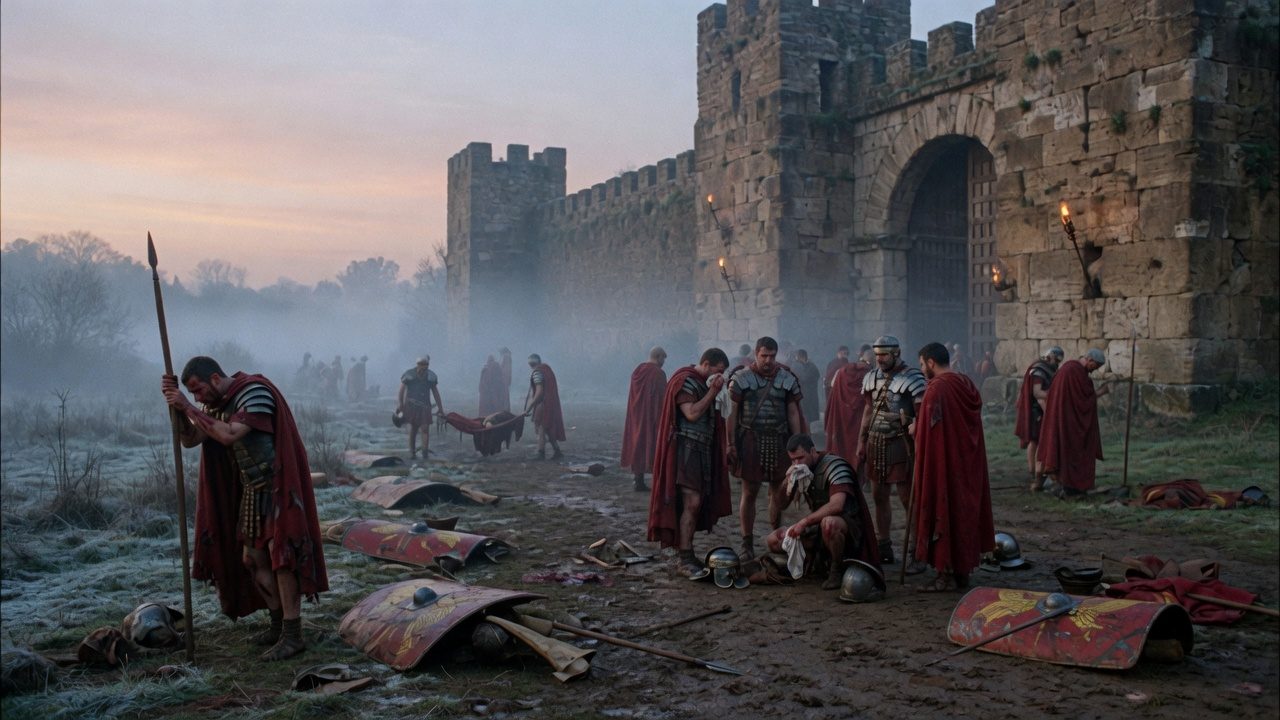
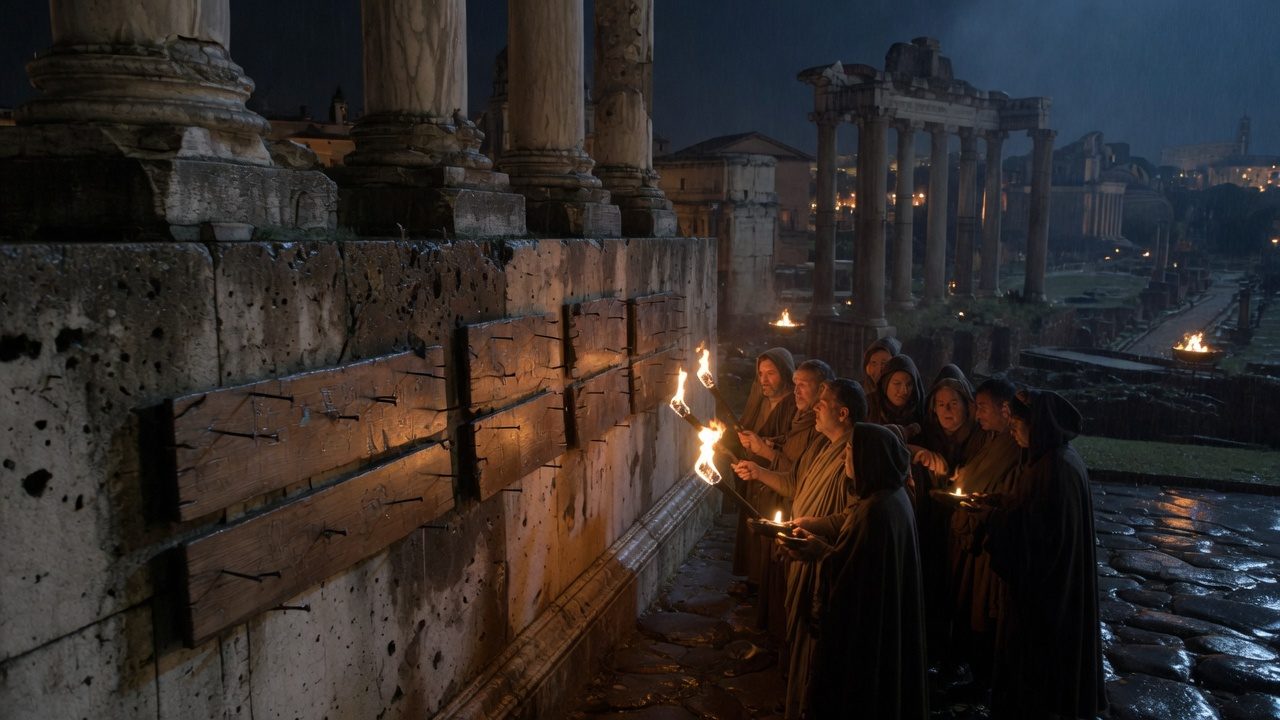
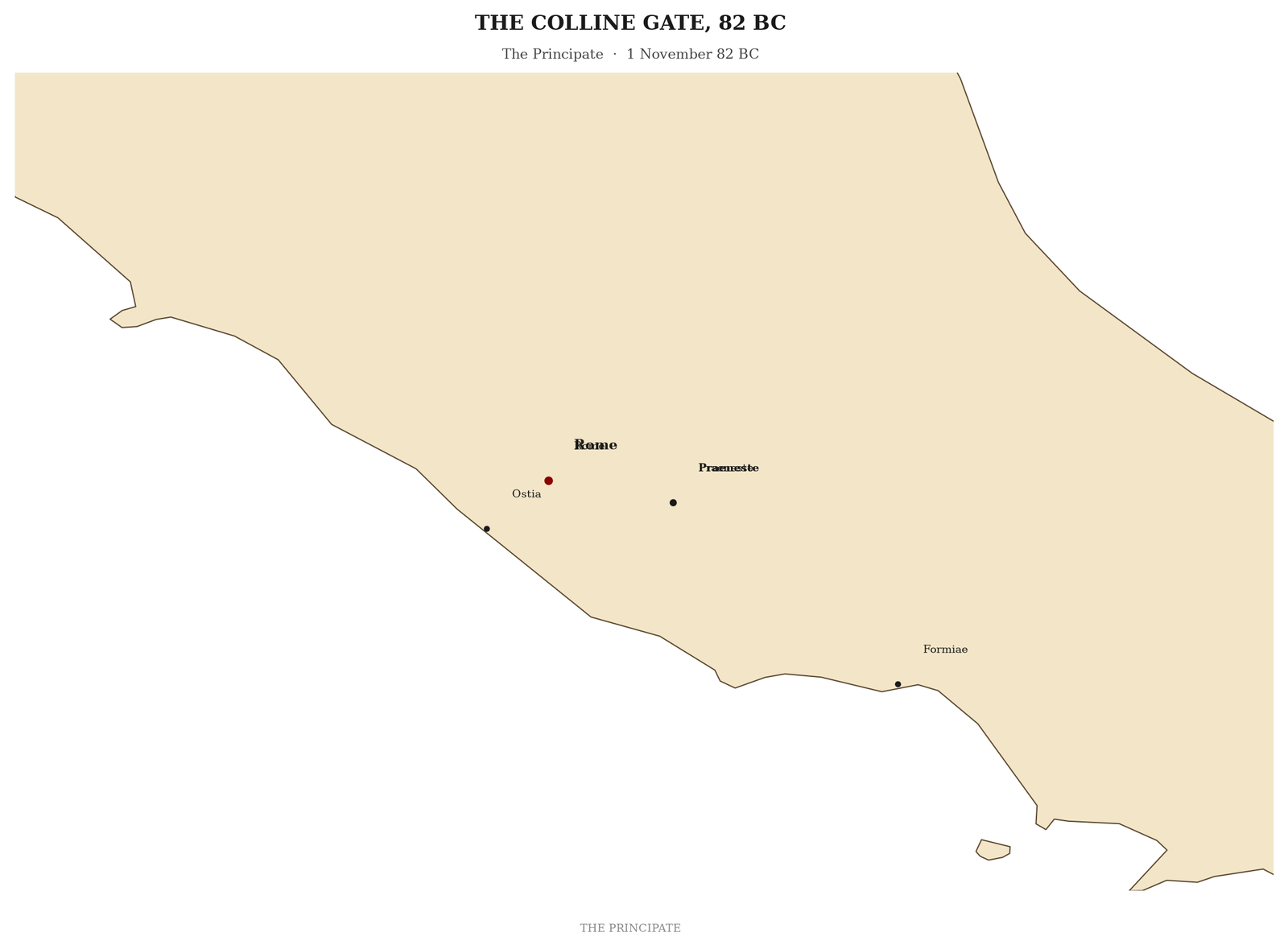
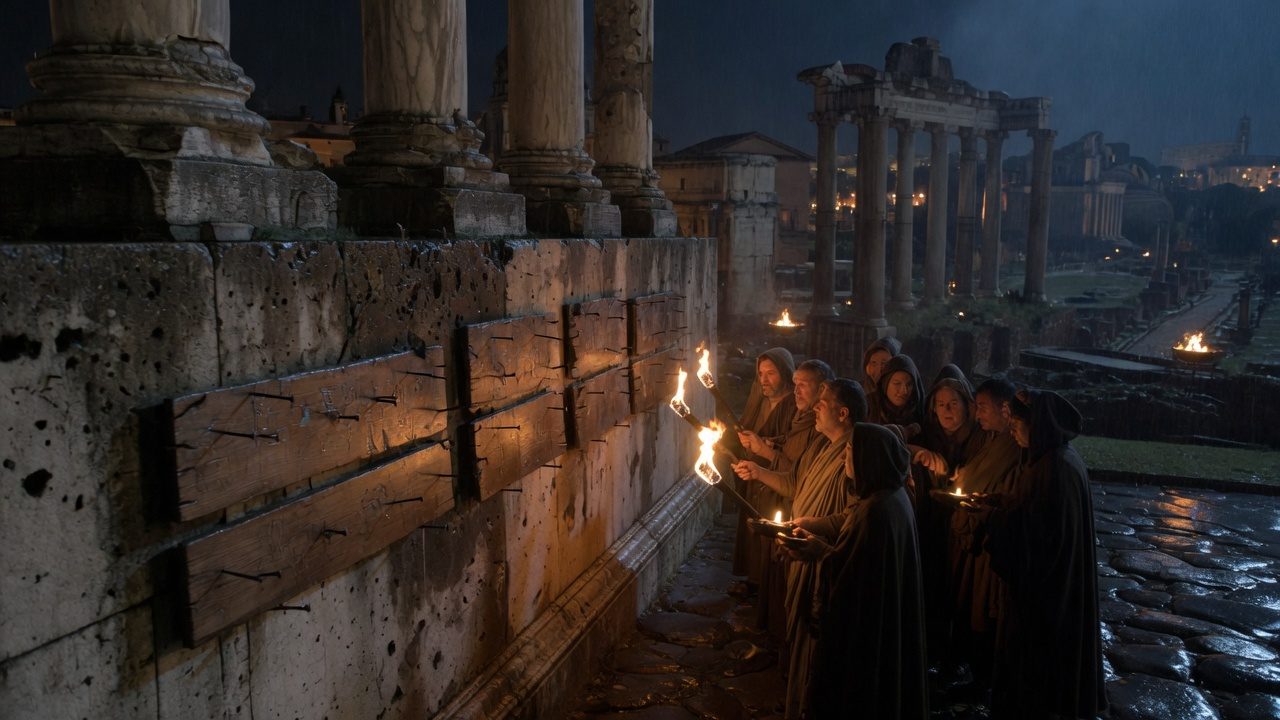
1 November 82. Colline Gate. Samnites broken in the night. Praeneste doomed. Young Marius dies. Prisoners killed while the Senate sits. Sulla dictator rei publicae constituendae. The lists.
81–80. Laws. Colonies. A packed Senate. Tribunes hobbled. Ofella killed in the Forum. Consul in 80 with Metellus Pius. The dictatorship is laid down — month argued, act not argued.
79–78. Campania. Memoirs. Actors. Valeria. Death at Puteoli, 78. Public funeral in Rome. The epitaph about friends and enemies.
70. Pompey and Crassus, consuls, restore much of what he took from the tribunes.
49. Caesar crosses the Rubicon with Sulla’s precedent and without Sulla’s retirement.
44–31. The rest of the lesson: lists again, armies again, and a man who does not walk away.
That is the line.
Plutarch will give you the face, the actors, the liver, the blotched luck. Appian will give you the wars and the boards in the Forum. Sallust will give you Africa as a sermon. Cicero will give you the air afterward, a young voice in a city that has learned to read a list.
The host’s job is not to pick a mascot.
A poor Cornelius.
A ring with a chained king on it.
A road from Nola.
A gate at dawn.
A name he chose.
Felix.
Leave air.
Then let the empty Forum sit until the music, if there is music, has the manners to wait.