JULIUS CAESAR — BLOCK E: EXTENDED THEMES & DEEP SCENES
Weave throughout OR append for maximum length
E1 — THE LATE REPUBLIC MACHINE
Julius Caesar does not walk into a healthy Republic and murder it for fun.
He walks into a machine already throwing rods.
The late Republic is a competitive aristocracy running a world empire with city-state software. Annual magistrates. Shared offices. Fear of kings baked into political religion. At the same time: permanent military recruitment pressures, provincial wealth beyond imagination, urban crowds that can be bought or inflamed, and generals who learn under Marius and Sulla that armies can rewrite law.
Sulla proves a dictator can massacre opponents and “restore” the Senate.
Pompey proves a young commander can become “the Great” outside traditional career tracks.
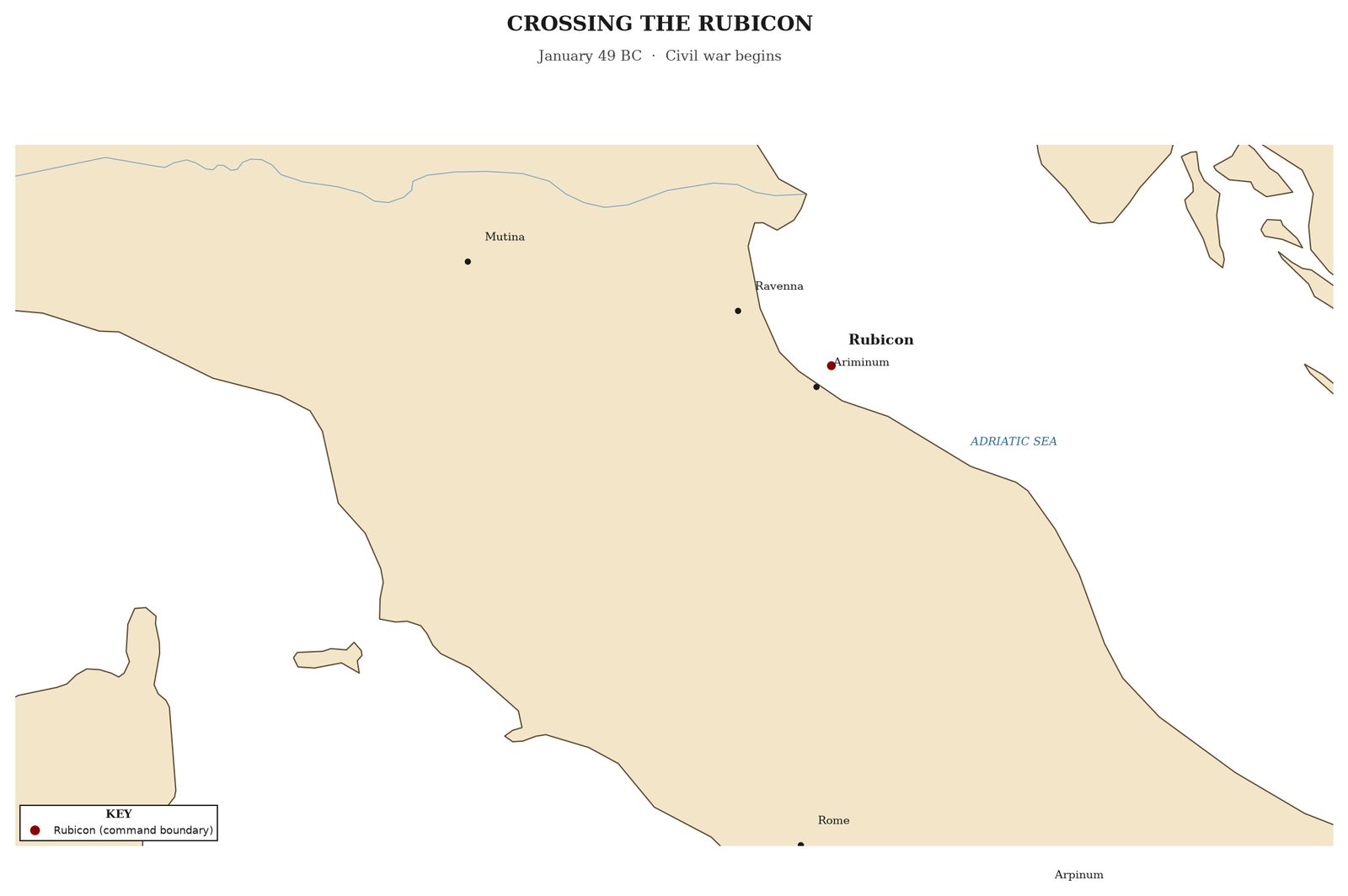
Crassus proves money can almost become consulship by itself.
The Gracchi, earlier, prove reform and blood can share a ballot box.
Caesar inherits every cheat code already discovered. His originality is integration: popular politics plus elite pedigree plus military genius plus literary self-mythologizing plus clemency branding plus relentless speed.
He is not the first symptom.
He is the syndrome becoming conscious.
E2 — FAMILY, MARRIAGE, WOMEN, ALLIANCES
Roman political careers run through households.
Caesar marries Cornelia, daughter of Cinna, tying him to the Marian faction in the Sullan terror years. He refuses Sulla’s order to divorce — a story of spine that also becomes a story of faction identity. Cornelia dies. Caesar later marries Pompeia, then divorces her after the Bona Dea scandal involving Publius Clodius Pulcher — the famous line attributed to him: Caesar’s wife must be above suspicion. Whether or not he said it that cleanly, the politics are clear: the pontifex maximus cannot afford sacral humiliation.
He marries Calpurnia, who will dream omens in the final days. His daughter Julia marries Pompey to seal the triumvirate; her death in childbirth removes a human bridge between two superpowers. Servilia — mother of Brutus — is linked to Caesar by ancient gossip as lover; the rumors around Brutus’s parentage are almost certainly political fiction, but they show how Romans sexualize power struggles.
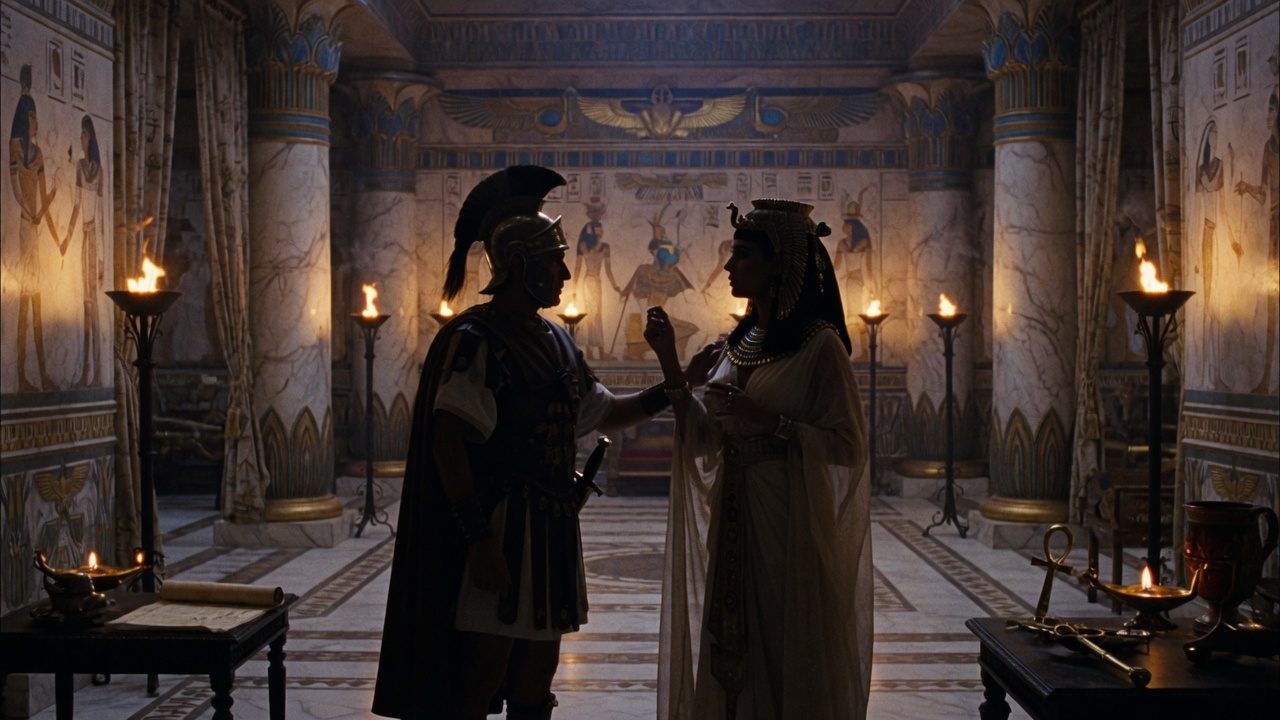
Cleopatra is the most myth-saturated relationship: dynastic partner, romantic legend, eastern “corruption” in hostile Roman propaganda, mother of Caesarion in tradition. For the documentary, hold two truths: personal entanglement can be real, and eastern queenship becomes a mirror in which Romans argue about what Caesar is becoming.
Women in Caesar’s story are not side quests. They are diplomacy, sacrilege risk, coalition glue, dynastic futures, and propaganda battlefields.
E3 — RELIGION, AUSPICES, AND POLITICAL MAGIC
Caesar is pontifex maximus — not a modern atheist in a toga, and not a village priest. Roman religion is public technology: calendars, priesthoods, auspices, the right to delay public action by watching the sky.
His enemies accuse him of mocking sacred blockers when he forces legislation in 59. Bibulus watches the heavens to freeze the year; Caesar drives past the freeze with popular assemblies and raw will. To conservatives, that is sacrilege dressed as policy. To Caesar’s supporters, it is government refusing to be held hostage by a weather report with political timing.
His final honors blur into quasi-divine territory. After death he is deified. The line between state cult and personal cult is exactly where republics get nervous — because once a man becomes sacred, opposing him starts to look like impiety, not politics.
A smart documentary does not laugh at Roman religion. It shows it as constitutional law wearing myth. The sky is a procedure. The priesthood is a power center. Caesar sits in both and uses both.
E4 — MONEY: DEBT AS DESTINY
Caesar’s early career is a masterclass in leverage.
He spends on games and public favor like a man who knows insolvency is only fatal if he fails. Beasts in the arena. Spectacles that make the city remember his name when election day comes. The bills stack. Creditors wait. Crassus helps underwrite him at key moments — rich man’s insurance on a rising operator.
Provincial command becomes debt solution. Gaul becomes wealth engine: plunder, slaves, clients, the kind of cash that turns a leveraged aristocrat into a man who can fund armies and politics at the same time. Civil war becomes the final refinancing of a life spent betting on victory.
This economic spine matters. It prevents the fairy tale of pure ideology. Caesar wants glory and solvency and primacy. Those wants are not separate from his popularis gestures. Bread, land, and veteran settlement are moral politics and accounting. Follow the money and you still find ambition — you just find it with receipts.
E5 — CAESAR THE WRITER
Caesar’s Latin is famous for clarity.
The Gallic War commentaries invent a voice: third-person, cool, efficient, “objective.” It is the ancestor of a thousand military memoirs that pretend not to be rhetoric. He selects facts, omits mess, frames aggression as necessity, and makes the reader complicit in admiration. You finish a campaign season feeling like you sat at the staff map — and somehow you are rooting for the author.
He also writes the Civil War commentaries; other works are lost or fragmentary. Even the losses matter: we are trapped seeing him partly through his own camera. What he chose not to preserve is gone. What he chose to polish is what schools still assign.
Compare Cicero’s overflowing self-revelation in letters with Caesar’s controlled surface. One man cannot stop confessing. The other refuses to confess and still dominates the archive. Different weapons. Same late Republic. Both of them understood that the written record is a second battlefield — and Caesar made sure his second battlefield looked inevitable.
E6 — THE FIRST TRIUMVIRATE AS SHADOW CONSTITUTION
The alliance of Caesar, Pompey, and Crassus is the Republic’s shadow charter.
It allocates consulships, provinces, legislation, and intimidation. Three men, private deals, public consequences. Luca in 56 BC renegotiates the bargain when strain appears — a summit of power outside the Senate’s full control. The Senate’s independent center is hollowed out. Men like Cicero discover that eloquence without an army is a beautiful hobby.
When Julia dies and Crassus dies, the triangle becomes a duel.
Duels between superpowers are civil wars waiting for a spark.
The spark is whether Caesar can be stripped of command safely.
He decides he cannot.
Pompey decides he must be.
The rest is Pharsalus.
Call it coalition. Call it conspiracy. Call it the moment the Republic’s real constitution stopped being the laws and started being three men’s handshake — until the handshake broke.
E7 — CATO AS FOIL
Cato the Younger is Caesar’s moral anti-matter.
Where Caesar is flexible, Cato is rigid.
Where Caesar pardons, Cato refuses the premise of pardon.
Where Caesar writes inevitability, Cato performs unbought virtue.
At Utica, Cato’s suicide denies Caesar the full victory of clemency. Later Stoics and republicans turn Cato into a saint. Caesar becomes the seductive tyrant; Cato the unbearable conscience. Real history is messier — Cato’s rigidity also helps destroy compromise politics, and purity can be a weapon that cuts the pure man’s own side — but the foil is dramatically perfect and educationally useful.
If Caesar is the question “What if competence should rule?”
Cato is the question “What if integrity refuses to live under competence’s boot?”
Rome never answers either question cleanly. It just buries both men and keeps arguing.
E8 — THE RUBICON AS POLITICAL PHILOSOPHY
Every republic eventually meets a Rubicon problem:
What do you do when a legal order tells a powerful citizen to disarm into a court system he believes is rigged — and he has the means to refuse?
If he submits, law wins and maybe justice dies.
If he refuses, justice for himself may win and law dies.
Caesar answers as men with legions often answer.
The assassins answer law’s death with murder and call it medicine.
Augustus answers with a disguised monarchy and calls it restoration.
The Rubicon is not only a river crossing. It is the moment legality and legitimacy split so far that only force can choose which word still means something. Once that split is open, every speech about “the constitution” has to share the room with cohorts. And cohorts are not impressed by speeches.
E9 — CLEMENCY VERSUS PROSCRIPTION
Sulla’s ghost haunts every civil war decision.
Proscription: kill enemies, seize property, terrorize survivors into silence.
Clemency: spare enemies, reintegrate them, claim moral superiority, hope gratitude outruns humiliation.
Caesar chooses clemency as brand and system. It works operationally — many serve him afterward. Cities open faster. Elites calculate. The civil war looks, for a while, less like a death list and more like a hostile takeover with generous severance.
It fails emotionally for a core of aristocrats who cannot bear a world where their lives are permanent gifts from one man. Being allowed to live is not the same as being free to compete as equals. Forgiveness from above is still hierarchy.
The Ides is the revolt of the ungrateful and the un-submissive at once. Both words are moralized depending on your politics. The structural point stands either way: spare a man and you may create a client — or you may create a conspirator who will never forgive you for the power to spare him.
E10 — THE IDES AS BOTCHED REVOLUTION
Tyrannicide only works as political technology if day two is better managed than minute two.
The conspirators prepare the kill more carefully than the aftermath. They assume the Republic is a sleeping beauty needing only the tyrant’s removal to awaken. But institutions are not sleepers. They are networks of interest. Kill the node without controlling the army, treasury, people, and provinces, and you have created a vacancy, not a restoration.
Antony occupies space.
Octavian invents a future.
The liberators occupy the moral high ground — a terrible tactical base.
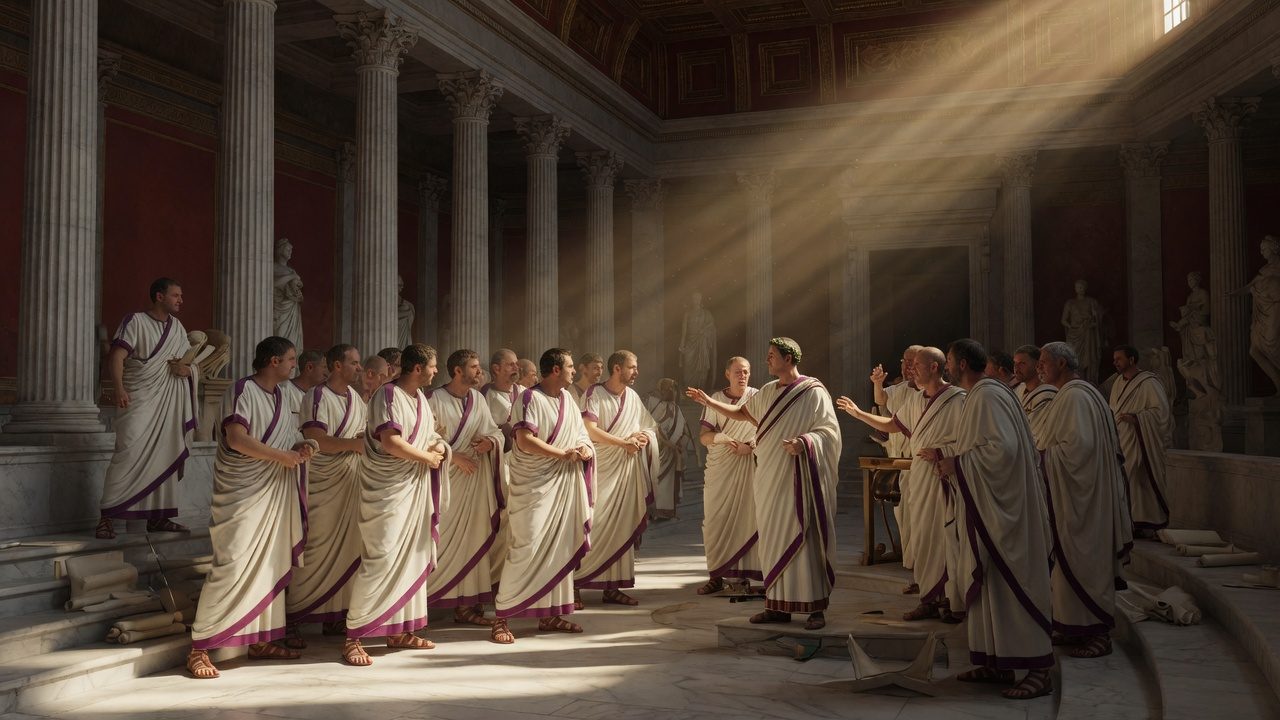
They have slogans. They have blood on the floor of Pompey’s curia. They do not have a settlement. Rome, which has lived through enough civil violence to be skeptical of press releases, waits to see who can pay soldiers and feed crowds.
Caesar’s murder is both success and fiasco: success as homicide, fiasco as regime change. The man dies. The system he was building does not die with him. It mutates into something the assassins like even less.
E11 — FROM DIVUS JULIUS TO EMPIRE
Caesar’s body dies.
Caesar’s name becomes sacramental.
Octavian’s adoption politics create Gaius Julius Caesar Octavianus — a living continuation. The deification of Julius creates a temple and a theology of the ruling house. Comets are read. Priests perform. The empire learns to wrap autocracy in sacred ancestry so that opposing the ruler starts to look like impiety as well as treason.
In that sense, the assassins do not erase Caesar.
They force him to become immortal in the one way Rome cannot reverse: religion plus succession.
You can stab a dictator.
You cannot easily stab a god whose adopted son still holds the legions.
E12 — MILITARY METHOD IN TEN LINES
1. Move faster than the enemy’s decision cycle.
2. Dig more than you speechify.
3. Turn engineering into intimidation.
4. Fight politics as logistics.
5. Be visible at the crisis point.
6. Reward centurions like co-authors of victory.
7. Write the war while fighting it.
8. Convert defeated peoples into future manpower when useful.
9. Punish revolt in ways neighbors will cite for decades.
10. Never arrive home without a story that makes prosecution look like envy.
That is Caesarism as practice, not slogan. You can teach it in a staff college without ever saying the man’s name — and then you look up and realize you have been teaching Caesar the whole time.
E13 — WHAT TO TELL A MODERN AUDIENCE
If you came for battles, you got them.
If you came for a simple moral, history refuses you.
Caesar shows how republics die of their own success: too much empire for their institutions, too much glory for their equality, too much debt for their virtue, too many veterans for their land system, too much talent in one person for their rotation of offices.
He is what happens when a society still speaks the language of shared rule while practicing the reality of emergency and personality.
You can condemn him for Gaul and for the Rubicon.
You can admire him for speed, clarity, reform, and the refusal to become Sulla reborn in bloodlists.
You can do both without contradiction — if you accept that history’s most important figures are often ethically non-portable. They do not fit in modern party colors.
The useful question is not “Caesar: good or bad?”
The useful question is: what design of institutions keeps extraordinary people from having to choose between self-destruction and dominating everyone else?
Rome never solved it.
It crowned the problem and called it Augustus.
E14 — FULL LIFE TIMELINE (on-screen lower thirds)
| Year | Event |
|------|--------|
| c. 100 BC | Birth of Gaius Julius Caesar |
| 84–82 | Marian connections; Sulla’s dictatorship era |
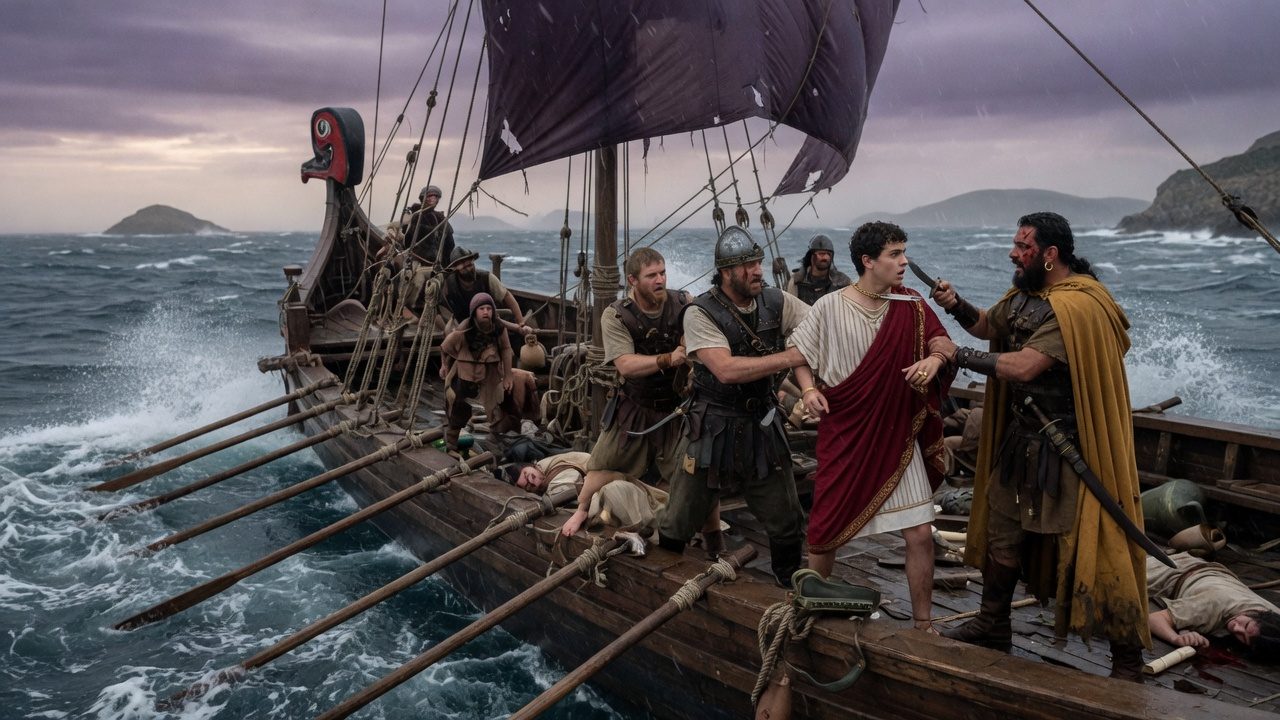
| c. 75 | Pirate captivity |
| 69 | Quaestor in Spain |
| 65 | Aedile — lavish games |
| 63 | Pontifex maximus; Catiline debate |
| 61–60 | Spain propraetorship |
| 60 | First Triumvirate formed |
| 59 | Consul with Bibulus |
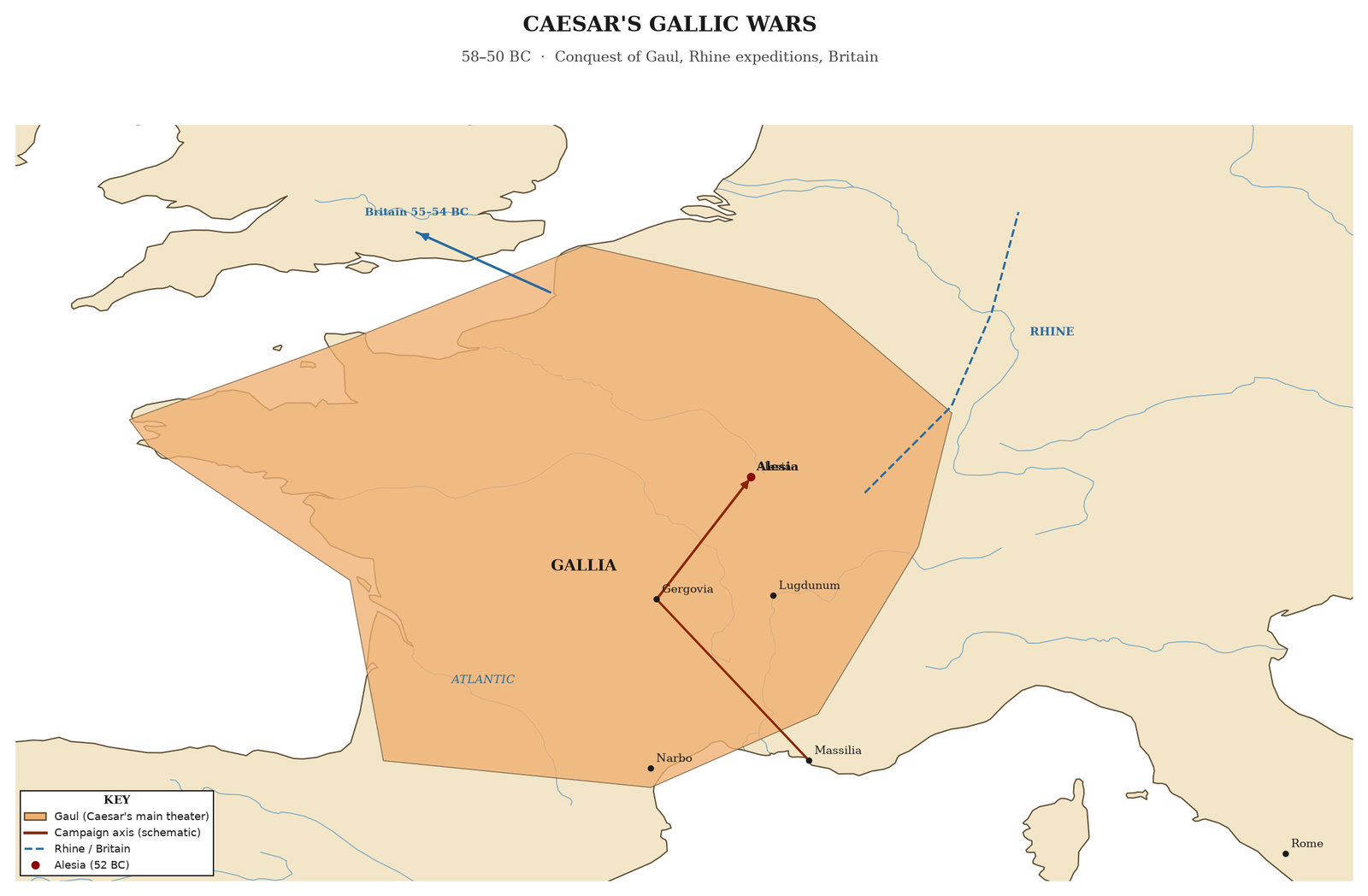
| 58–50 | Gallic Wars |
| 55–54 | Britain expeditions |
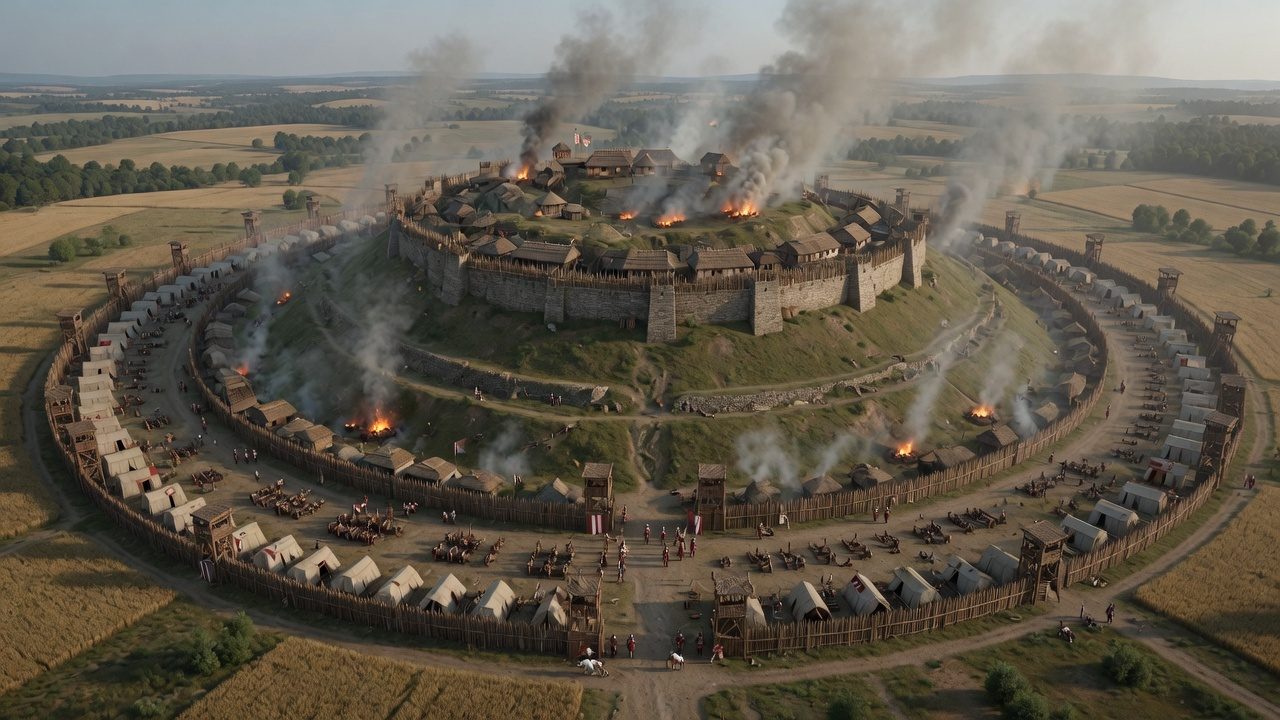
| 52 | Alesia; Vercingetorix surrenders |
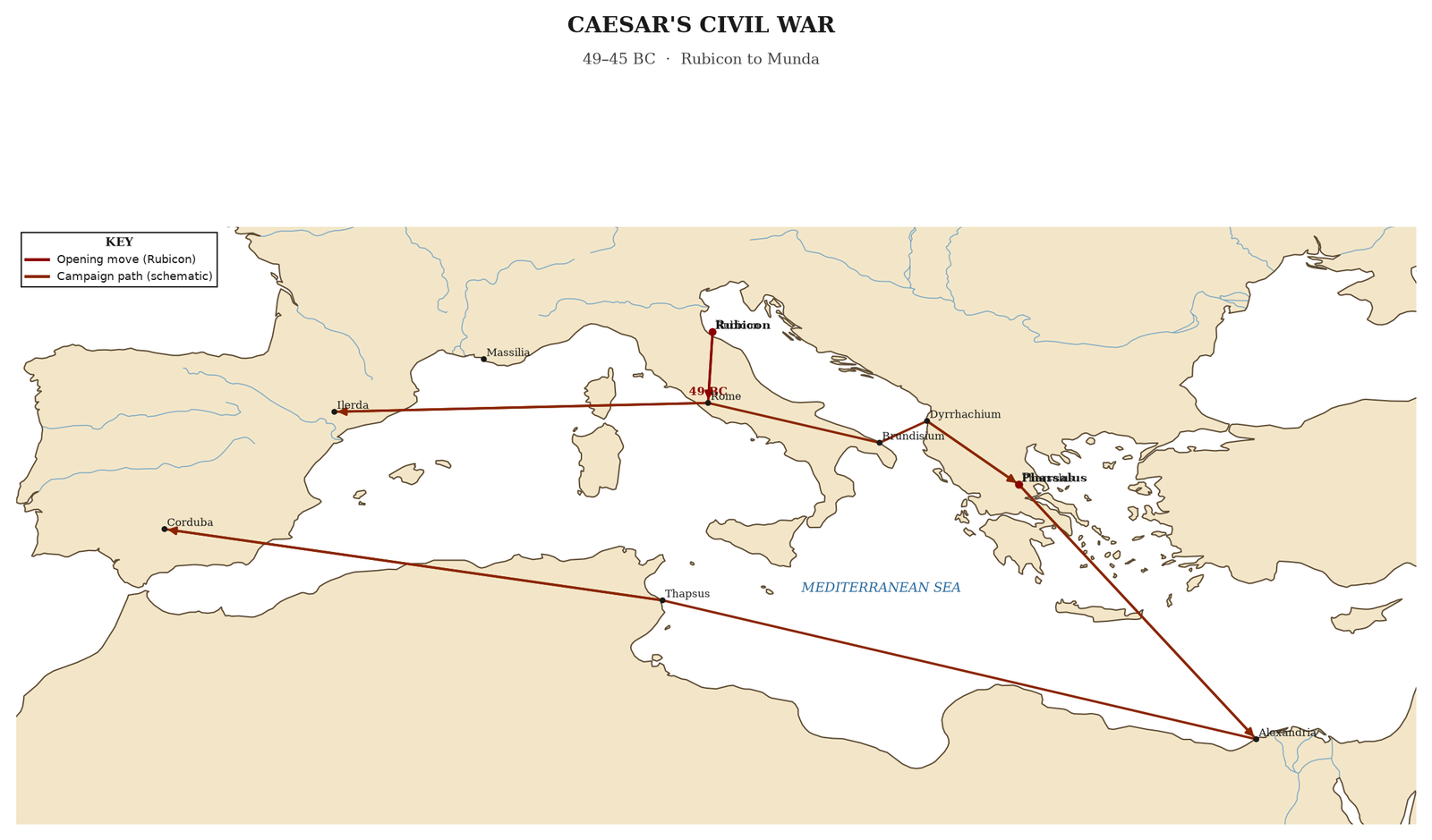
| 49 | Crosses Rubicon; civil war begins |
| 48 | Pharsalus; Pompey killed in Egypt |
| 47 | Zela — Veni, vidi, vici |
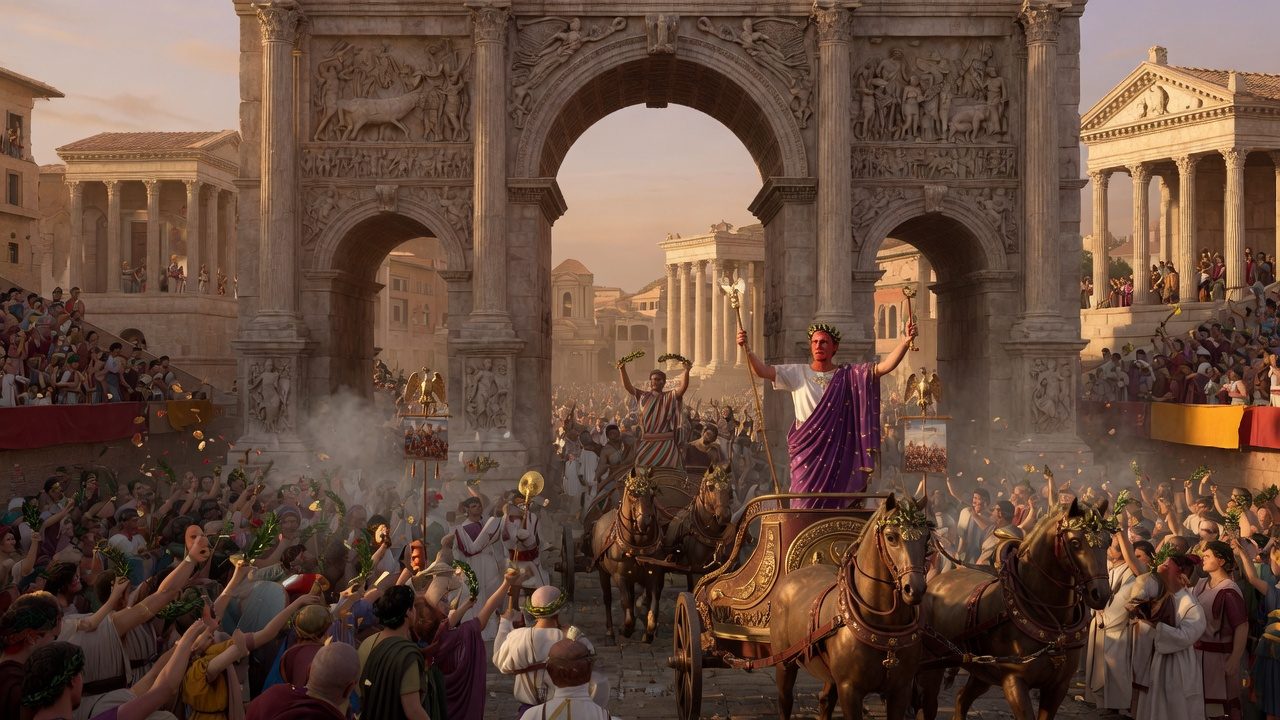
| 46 | Thapsus; Cato’s suicide; triumphs; calendar reform |
| 45 | Munda |
| 44 Feb | Dictator perpetuo |
| 44 Mar 15 | Assassinated on the Ides |
| 42 | Philippi — assassins defeated |
| 31–27 | Octavian wins; principate begins |
E15 — PRONUNCIATION GUIDE
| Name | Say |
|------|-----|
| Gaius Julius Caesar | GUY-us JOO-lee-us SEE-zer (classical KAI-sar optional) |
| Pompey | POM-pee |
| Crassus | KRASS-us |
| Vercingetorix | ver-sin-JET-uh-riks |
| Alesia | uh-LEE-zhuh / ah-LEH-see-ah |
| Pharsalus | FAR-suh-lus |
| Cleopatra | klee-uh-PAT-ruh |
| Rubicon | ROO-bih-kon |
| Pontifex maximus | PON-tih-fex MAX-ih-mus |
| Veni vidi vici | WAY-nee WEE-dee WEE-kee (classical) / VEH-nee VEE-dee VEE-chee (common) |
| Alea iacta est | AH-lay-ah YAHK-tah est |
E16 — CLOSING ORATION (long cut finale)
Gaius Julius Caesar was born into myth and debt.
He died in a committee of knives.
Between those two facts he conquered a world and unmade a constitution.
He taught Rome that charisma plus legions can outvote mos maiorum — the custom of the ancestors.
He taught later ages that the man who “crosses the Rubicon” becomes a proverb because every generation meets a river it is not supposed to cross.
The Republic wanted him to be one more consul in a list.
History made him a title, a month, a warning, and a temptation.
March 15th removed the man.
It could not remove the pattern.
And that is why, two thousand years later, we are still afraid of him —
and still, against our better judgment, impressed.
End Block E